Summary 2 | In a Stable Organization, Leave a Place for Uncertainty
These are Robin Shen’s original reading notes and commentary, written in his own words after reading Eric Ries’s The Lean Startup: How Today's Entrepreneurs Use Continuous Innovation to Create Radically Successful Businesses. They are not the original book, excerpts from it, or an official publication. Methods and concepts from the book are attributed to Eric Ries; other sources are identified where stated. For reference only; not investment advice.
English translation of Robin’s Chinese reading notes and commentary. Passages are paraphrased, not verified verbatim quotations from the original English edition.
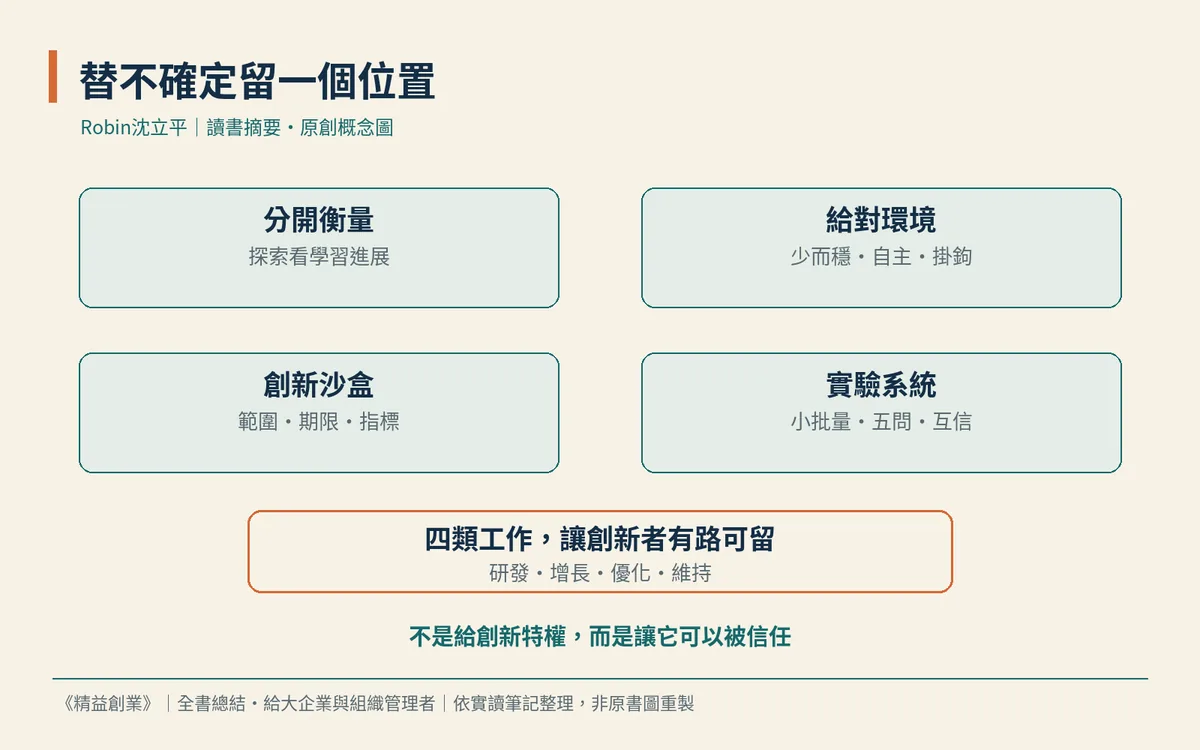
Many managers who read The Lean Startup think it is a book written for founders in a garage. In Chapter 2, Eric Ries already widens the definition: a startup is a human institution designed to create a new product or service under conditions of extreme uncertainty. What matters is how large the unknown is, not how young or how small the company is. By that definition, a new venture inside a large company, and a new program in government or a nonprofit, can all use the same method. The book’s sharpest reminder for managers is that an organization’s problem is often not a lack of effort, but doing the wrong thing very efficiently.
In Chapter 13, Ries uses Drucker and Taylor to explain that twentieth-century management learned how to do things well, and that the difficulty of the twenty-first century has become whether they should be done. If exploratory work is still measured by being on time, on budget, and by how much was finished, teams will naturally deliver only visible output, and avoid experiments that might reveal a wrong direction. So a manager’s first task is to measure exploratory work and a mature business separately, and to have a cross-functional team accountable for a learning goal in each phase.
The second task is to give the right environment. As Ries quotes from the team’s own account, Intuit’s internal SnapTax team drew its talent from inside the company, was given autonomy by senior leaders, and started small, with a modest budget. Chapter 12 then summarizes three structural characteristics: scarce but secure resources, development authority within the scope of a mandate, and personal performance tied to results. Ries stresses that the right structure is only a prerequisite, and that a wrong structure almost guarantees failure.
The third task is to protect the parent company, and also to protect innovation. Ries does not favor hiding the innovation team. He regards an isolation like IBM’s in Boca Raton as hard to copy, and as something that also breeds politics. He proposes an innovation sandbox: a limited scope, time, and share of users; the team is responsible throughout; every test uses the same report of five to ten metrics; and if something goes wrong, it is stopped.
The fourth task is to build a system that makes experiments faster and cheaper. Small batches let errors surface earlier; continuous deployment needs automated safeguards; the Five Whys aim the fix at the root cause, and first establish mutual trust, so that the Five Whys do not become the Five Blames. According to an Intuit executive, after the TurboTax system was upgraded, as many as five hundred experiments could be run in one tax season. This is a company account Ries quotes.
Finally there is talent and self-renewal. Ries divides the work into four kinds—research, growth, optimization, and maintenance—and argues for making the corporate entrepreneur a concrete role. After a product matures it can be handed off, and innovators need not leave the company in order to advance. He also admits that today’s reformer may become tomorrow’s gatekeeper, and that when a new method is introduced the experience is often bitter first and sweet later.
In Chapter 13 Ries also tells the story of an unnamed student: this junior employee asked only a few simple questions in a meeting, made everyone see that the project was built on testable hypotheses, and was called a genius by colleagues. Ries’s reading is that the advantage came from a theory that can predict results, not from talent. What a manager should truly do is turn this way of asking questions into a system everyone can use, rather than going out to find still more star employees. Ries also says that putting the system first is not the same as not needing talent. Vision and perseverance, precisely because they are precious, should even less be wasted on a wrong direction.
I think this part reads most like a manager’s checklist for self-examination. The conclusion is that a large organization does not lack resources. What it lacks is a place where the unknown can be measured honestly, small experiments can be protected, and someone is accountable for learning. Designs such as the sandbox and the accounting are not a privilege granted to innovation. They are what let it be trusted.
Ten takeaways
Whether entrepreneurial methods should be used does not depend on whether a department is new or old, but on how large the unknown is. Inside a mature company there is likewise work that needs to be managed as a startup.
Measuring every department with the same yardstick will make an exploratory team deliver only visible output, and learning will in fact be punished.
“We learned a lot” has to be capable of being tested by evidence. Otherwise it is only a respectable way of talking about failure, and a manager’s distrust is reasonable.
What a startup-style team needs is not a loose budget, but a small, stable commitment that will not be diverted on short notice.
Authority is meaningful only when it has a boundary. Layers of approval slow feedback, and also dilute the sense of responsibility.
Hiding innovation cannot protect it. A transparent, controlled sandbox can instead let the worries of the old business be laid out and handled.
A unified standard report lets the whole company gradually form a shared language, and the argument shifts from who is better at speaking to how the metrics are changing.
Speed and quality need not be a choice of one or the other. The more problems there are, the more one should invest in repairing the root cause, and a mechanism that regulates speed forms naturally.
If innovators can only travel with the product into optimization and maintenance, the organization’s scarcest pioneering talent will be slowly consumed.
The method of management itself is also a hypothesis. When a new system is introduced, a possible temporary slowdown should be announced in advance, and the method should be tested by the same standard.
Ten concrete suggestions
Take stock of the projects in hand, mark which of them are in conditions of high uncertainty, and set for them a separate form of assessment centered on progress in learning.
For each internal pilot, form a small cross-functional team, and from engineering, marketing, customer service, and other departments appoint one dedicated person to take part throughout.
For the pilot, write a dedicated budget and a period of security, and agree that unless a condition written in advance is triggered, there will be no sudden cut within the period.
List the matters the team may decide without prior approval, and make the list known to the managers involved.
Draw the first innovation sandbox, and write the scope it covers, the time limit of the experiment, the upper limit on the share of affected users, and the conditions for stopping.
Set a standard experiment report of five to ten metrics, and have every experiment inside the sandbox report in the same format.
Find the approval or release step that most often slows an experiment, and first shrink the batch or add an automated check for one of them.
Change the next review of an incident to the Five Whys, and first announce the rule of being tolerant of a first mistake and not letting the same error happen again.
Establish a clear title and path of promotion for internal entrepreneurs, so that they can choose to follow the product or turn back and start a new project.
Before introducing any new method of management, first have a small team try it, and write in advance the expected effect and the period of observation.
#TheLeanStartup | Source: Book-wide summary for large companies and organizational managers (based on notes from the front matter through the acknowledgments, and Notes 0–43)
These are reading notes and reflections based on my personal understanding. I recommend reading them alongside the original book for the full context.
Comments
What do you think? Share your experience or questions.
Sign in to comment, reply or like. Sign in / Sign up
Loading comments…