Summary 3 | What a Board Should Ask Is Not How Fast You Are Growing, but How Truly You Are Learning
These are Robin Shen’s original reading notes and commentary, written in his own words after reading Eric Ries’s The Lean Startup: How Today's Entrepreneurs Use Continuous Innovation to Create Radically Successful Businesses. They are not the original book, excerpts from it, or an official publication. Methods and concepts from the book are attributed to Eric Ries; other sources are identified where stated. For reference only; not investment advice.
English translation of Robin’s Chinese reading notes and commentary. Passages are paraphrased, not verified verbatim quotations from the original English edition.
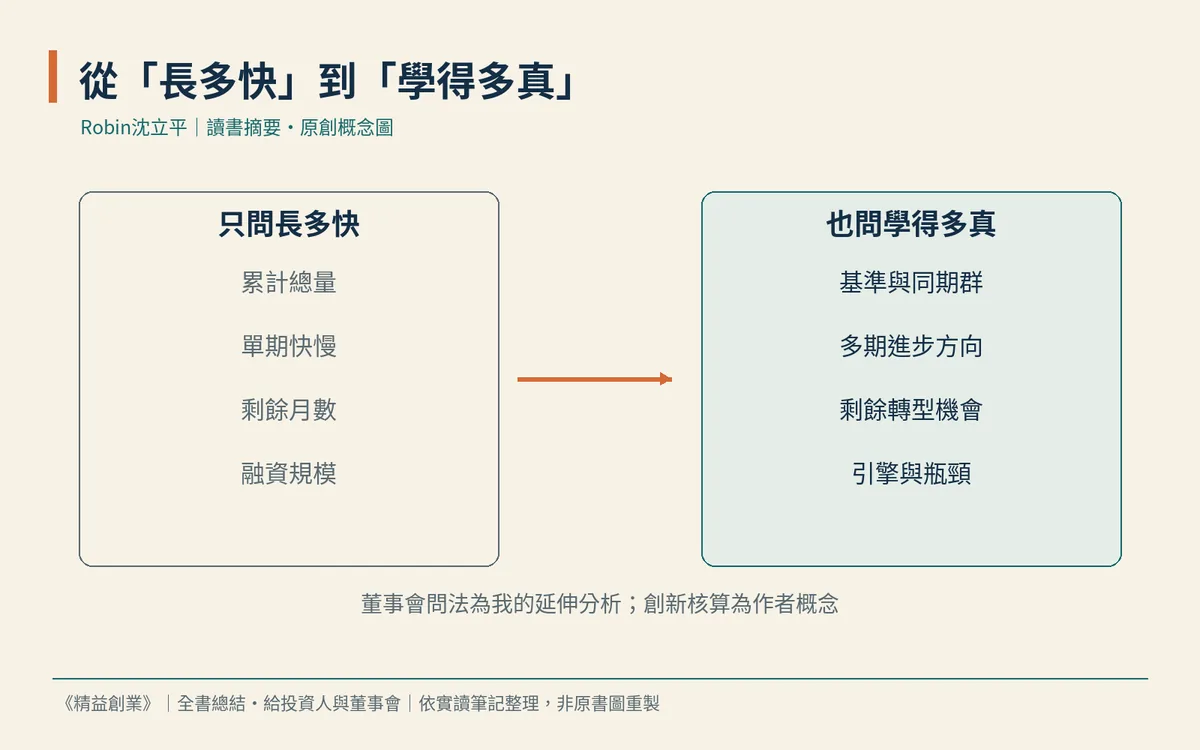
This book has no chapter written especially for investors, but Eric Ries keeps meeting the same question: when an early forecast falls short, how is a finance lead or a venture investor to judge whether a valuable lesson has been learned, or whether there has been slackness and an error of decision? His answer is innovation accounting. In what follows, unless Ries’s own words are noted, the operating angle for investors and boards is an analysis I extend.
First, the parts Ries states clearly. As he recalls, IMVU’s early revenue was only a few hundred dollars a month, and some investors once suggested taking the product down and returning to stealth development. Fortunately, some early investors understood validated learning, and were not misled by the pitiful revenue. He also admits that gimmicks or large amounts of advertising can pull the numbers up, but a false prosperity is hard to sustain. IMVU is Ries’s own company, and he also discloses that he has worked with several venture firms as an advisor or limited partner. This background should be kept in mind when reading.
Ries’s analysis of Facebook’s early financing is also worth investors reading carefully. Reportedly, what most impressed investors was not the total number of users, but two early metrics: more than half of users visited every day, and, without marketing spend, the service quickly covered the first campuses, corresponding exactly to the hypotheses of value and of growth. Ries uses “reportedly.” This is an anecdotal account.
Extended to the board, the first tool is the cohort and the baseline. A curve of totals tells us the scale, but cannot prove that the current period’s product work is effective. Table 8 in the book compares the compounding rates of two sticky companies: A rose gradually from 0.1 percent to 5 percent; B stayed around 10 percent. Looking at the latest period, B is faster; looking at the direction, A is improving.
The second tool is pivot or persevere. Ries suggests a regular meeting: the product team reports a long-term comparison; the business team brings customer interviews; IMVU also invited outside advisors to take part. I think a board can make this kind of meeting a fixed item on the agenda, and discuss runway by remaining opportunities to pivot, not only by remaining months. Ries also reminds us that a pivot needs a new hypothesis and a new minimum viable product, and cannot be only a change of wording.
The third tool is the engine of growth. Ries points out that for a paid engine to be sustainable, the cost of acquisition has to be paid by operating revenue, not by a one-time injection of capital. By extension, financing provides time for trial, but the scale of spending alone cannot prove that the loop is established. In an assessment, the team should be asked to state clearly the main engine and the bottleneck.
There are two further reminders, likewise from cases in the book; extending them to an investment judgment is my view. Votizen once turned to selling to organizations and received a good deal of interest and letters of intent. As Ries recounts, when it came time to sign, customers delayed or pulled back one after another. A willingness to hear a pitch, or to express an intention, does not mean the other party is already an early customer ready to adopt. Ries also quotes his mentor, the venture capitalist Shawn Carolan: startups usually do not starve; they drown. For a board, this means that rather than urging the team to do several more directions, one should help it delete the small optimizations that cannot produce validated learning.
In Chapter 13 Ries also proposes the idea of a long-term stock exchange, arguing for reporting internal entrepreneurship through innovation accounting and for tying executive pay to long-term performance. This is Ries’s proposal. The book does not report results of implementation.
I think the most valuable question an investor can ask is not necessarily how fast you are growing, but what you proved in the last round, and what you therefore changed. The conclusion is that only by turning the board from an occasion for chasing numbers into an occasion for testing hypotheses can true learning be distinguished from a handsome story.
Ten takeaways
Ries states clearly that traditional accounting struggles to tell whether a shortfall is a lesson learned or an error of execution. Innovation accounting is designed for this.
As Ries recalls, early investors who understood validated learning saw substantial progress beyond the revenue numbers.
Vanity metrics can reassure investors in the short term, but Ries’s view is that a false prosperity will finally be exposed by the fundamentals.
The Facebook case suggests that if early metrics are aimed at the hypotheses of value and of growth, they can say more than totals about whether the company is being established.
Table 8 shows that looking at the direction matters more than looking at a single period. An engine that starts high but has stalled may provide cover for ineffective product work.
An extended analysis: measuring runway by the remaining number of pivots can let a board move the discussion from cutting costs to the speed of learning.
A pivot-or-persevere meeting needs both data and interviews. Data alone tell you that something is not working; interviews help you see where to turn.
Ries states clearly that paid acquisition should be paid for by revenue. By extension, the scale of financing itself cannot prove that a growth loop is established.
An extended analysis: if investors require the team to write predictions in advance, a story after the fact can be turned into a commitment that can be tested.
When reading the cases throughout the book, remember that Ries has an interest in companies including IMVU and Votizen, and that the cases are participants’ accounts.
Ten concrete suggestions
Ask a portfolio company, before each board meeting, to submit a one-page comparison of the baseline, the previous period’s hypothesis, the actual result, and the next decision.
Require key behavioral metrics to be presented by cohort, and put totals only in an appendix as a reference for scale.
Every two or three board meetings, arrange a pivot-or-persevere item on the agenda, and invite the team to bring both long-term comparative data and records of customer interviews.
Together with the team, convert runway into how many meaningful rounds of experiment can still be completed, then discuss which spending should be cut and which should be kept.
In due diligence, ask the founder to explain the main engine of growth in one sentence, and to point to the bottleneck metric that is currently largest.
When examining a model of paid acquisition, list separately the part supported by revenue and the part supported by financing.
When you hear a proposal to pivot, ask separately why the old assumption needs to change, on what basis the new assumption is worth trying, and what the new plan for validation is.
For a company that is not yet profitable, agree on two or three key hypotheses that should be validated or rejected each quarter, not only a revenue target.
When a portfolio company has an internal new venture, confirm whether the period of security for its budget, its decision rights, and the attribution of results have been written clearly.
When an investment meeting cites a case from the book, also mark Ries’s interest and the limits of the source, and do not treat the account as a settled conclusion.
Robin’s note | Taiwan startups and venture capital
If an early-stage fund in Taiwan wants to try this way of asking, it can first pick one or two portfolio companies, use a comparison table of hypotheses in post-investment meetings over three months, then compare whether the discussion has become more focused before deciding whether to extend it. This is a conditional suggestion about process. It does not describe the current practice of any fund.
#TheLeanStartup | Source: Book-wide summary for investors and boards (based on notes from the front matter through the acknowledgments, and Notes 0–43)
These are reading notes and reflections based on my personal understanding. I recommend reading them alongside the original book for the full context.
Comments
What do you think? Share your experience or questions.
Sign in to comment, reply or like. Sign in / Sign up
Loading comments…