Note 2 | Leadership Takes More Than Selling: Connect Product, Talent, and Operations
These are Robin Shen’s original reading notes and commentary, written in his own words after reading Tren Griffin’s A Dozen Lessons for Entrepreneurs. They are not the original book, excerpts from it, or an official publication. Methods and concepts from the book are attributed to Tren Griffin; other sources are identified where stated. For reference only; not investment advice.
English translation of Robin’s Chinese reading notes and commentary. Passages are paraphrased, not verified verbatim quotations from the original English edition.
A Dozen Lessons for Entrepreneurs — Chapter 2, “Bill Campbell” (Part I, “The Founder Coaches”)
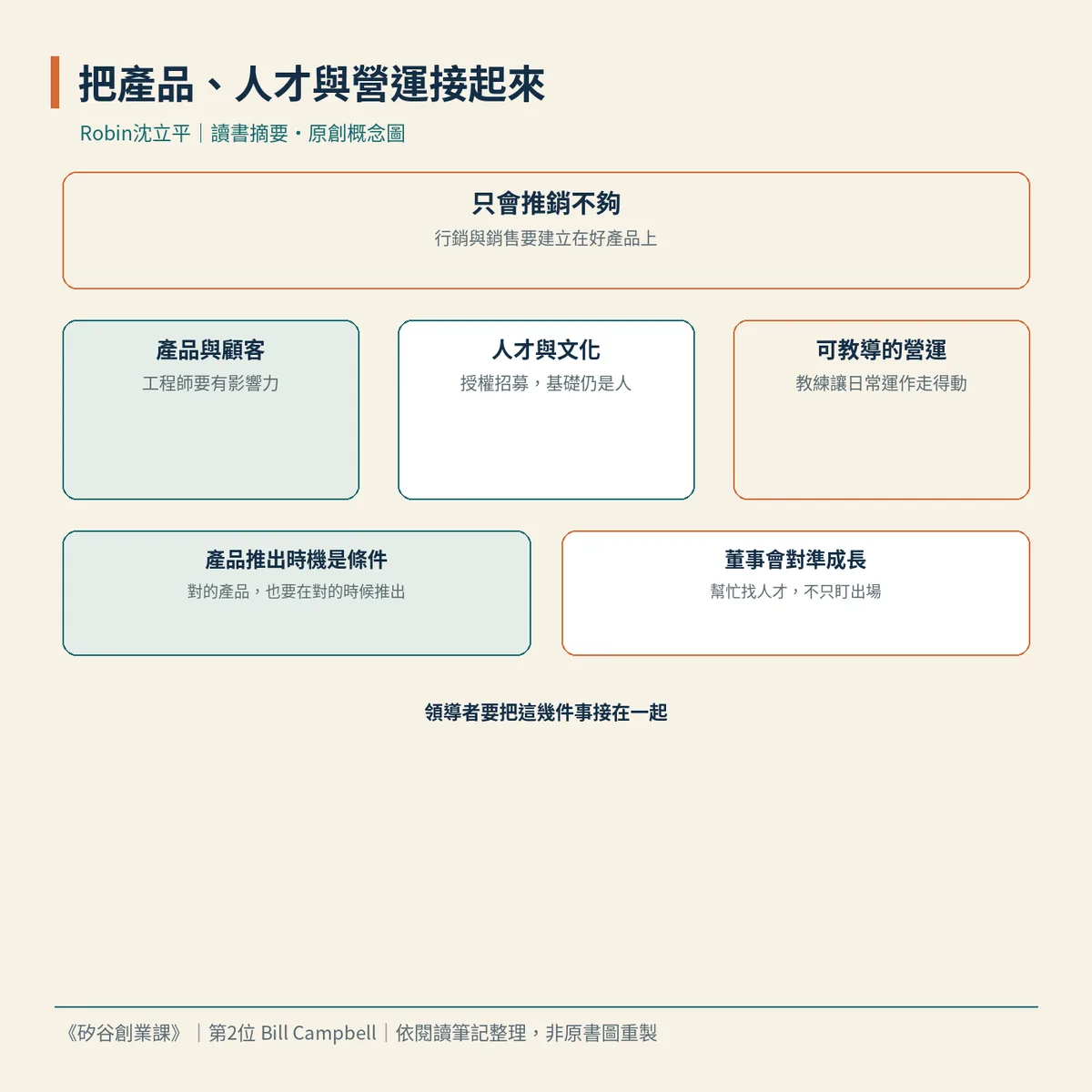
The book recounts that Bill Campbell was a college football coach before becoming Apple’s vice president of marketing. He served on the boards of Apple and Intuit and coached many leaders. The point is to connect product, talent, and operations, rather than simply to be good at selling.
Campbell connects growth with innovation: excellent marketers cannot deliver innovation on their own. The author explains that Campbell valued empowering engineers and giving employees with unusual ideas a chance to speak. Engineers should have influence in an innovative organization. Marketing matters, but it cannot replace the product. Campbell also recalls that, in earlier years, some people wanted chief executive officers (CEOs) who understood sales but not products or technology. Leaders who can only sell and do not understand the product can easily end up constrained by those who do. Sales should explain directly what the product does and how it helps customers, rather than mystify the process as entertaining clients, giving gifts, and manipulating the atmosphere.
Caring about customers starts with understanding their real needs. Campbell says he learned this principle from Steve Jobs. The author recounts that when Campbell discussed research and development (R&D) with Jobs, Jobs demanded more concrete thinking: users would struggle to provide feedback if they could not imagine the product. Campbell, meanwhile, believed marketers might not conceive of such entirely new products in advance but could make them better. A product must be concrete enough to elicit useful feedback, which can then guide improvements. Getting the product right is still not enough. Campbell states clearly: if a company does not have the right product, or launches it at the wrong time, it will not succeed. The author goes on to explain that companies may focus on growth and neglect a valuable product. Even a useful product can go wrong without the right talent, or if it launches too early or too late.
Connecting these conditions also requires talent and operations. Campbell argues that leaders need to find people who know how to build company culture. Leaders do not need every innovative ability themselves, but they must cultivate innovation, delegate hiring, and ensure the team has the qualities the company needs. The author explains that great people attract more great people. People remain the foundation. Operating skills can also be taught. Given a period of working together, Campbell could teach processes and practices, helping people think through how to organize the business and manage information. They could then be evaluated on task outcomes, with both high expectations and support for employees. This is closer to coaching: helping daily operations function rather than inventing the team’s vision for it.
The same thread runs through board work. Campbell argues that investors should focus on portfolio companies’ growth and help find talent when needed, rather than watch only for an exit. On boards, he would shield companies from pressure focused only on exits or sales numbers. The author adds that good venture capital networks can connect companies with talent, capital, distribution channels, and customers. If you participate in board meetings, ask yourself: Are you helping the company connect product, talent, and operations, or just watching for the moment to exit?
The conclusion: leaders need more than the ability to sell. First understand the product and customer needs, give engineers and other talent room to contribute, then establish solid execution through teachable operating practices and the right launch timing. Marketing and sales must rest on a good product. Board support should focus on growth, rather than solely on an exit.
One deeper insight
I think that when teams suggest “finding someone who can sell to lead us,” they often treat product understanding, talent selection, and daily operations as things to fill in later. A more useful check is whether this leader can explain what problem the product solves for whom, bring in the right people, and ensure that when daily operations go wrong, someone is actually teaching and making corrections.
Three suggestions
First, ask the person currently making the final decisions to write one page explaining what problem the product solves for whom, what engineering and marketing each do today, and who is accountable for operating results. If the page contains only sales pitches, gather firsthand product and customer observations before discussing expanded sales.
Second, for the next product launch, separately assess “Is the product itself right yet?” and “Is launching now too early, too late, or just right?” Both columns need observable reasons. Do not decide solely on “Any further delay will be too late” or “More refinement will definitely make it better.”
Third, if you participate in board work or investment decisions, first identify the talent or operating support the company currently needs. After the meeting, confirm who will take responsibility and when they will report back. Also examine whether near-term exit demands fit the company’s current stage of development.
#ADozenLessonsForEntrepreneurs #BillCampbell #ProductAndOperations #ReadingNotes
These are reading notes and reflections based on my personal understanding. I recommend reading them alongside the original book for the full context.
Comments
What do you think? Share your experience or questions.
Sign in to comment, reply or like. Sign in / Sign up
Loading comments…