Note 10 | Turn Deep Market Knowledge and a Secret Into a Prototype You Can Test
These are Robin Shen’s original reading notes and commentary, written in his own words after reading Tren Griffin’s A Dozen Lessons for Entrepreneurs. They are not the original book, excerpts from it, or an official publication. Methods and concepts from the book are attributed to Tren Griffin; other sources are identified where stated. For reference only; not investment advice.
English translation of Robin’s Chinese reading notes and commentary. Passages are paraphrased, not verified verbatim quotations from the original English edition.
A Dozen Lessons for Entrepreneurs — Chapter 10, “Chris Dixon: Andreessen Horowitz” (Part II, “The Venture Capitalists”)
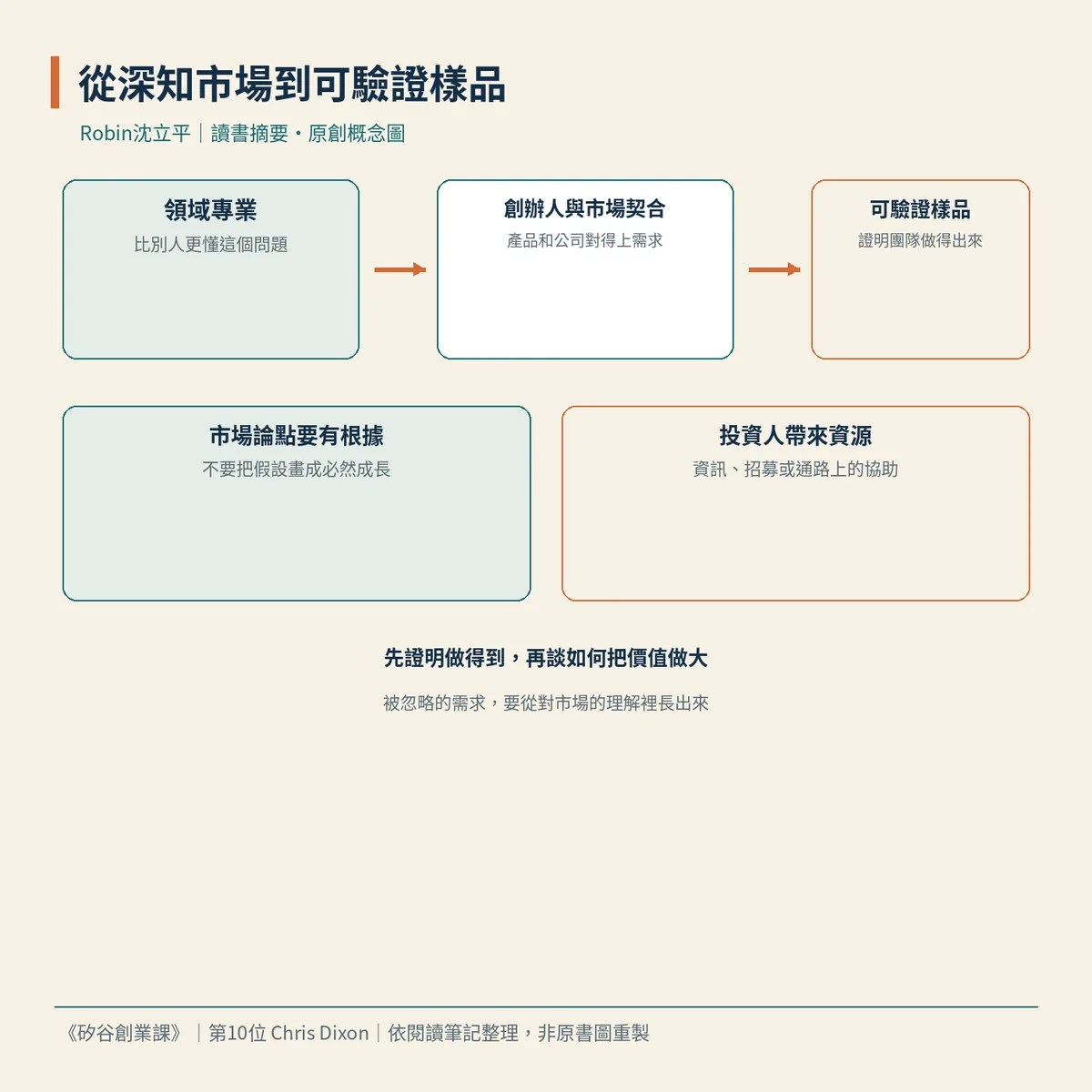
The book introduces Chris Dixon as an entrepreneur, programmer, and investor who was a general partner at Andreessen Horowitz when it was written. Start with deep knowledge of a market to identify a need most people still dismiss. Then build a testable prototype that proves the team can deliver. Market size and the resources investors can provide are conditions for scaling that value later. Optimistic spreadsheet assumptions cannot replace them.
Dixon cites Peter Thiel’s idea of a “secret”: believing something most people have not yet discovered. There are roughly three paths to finding such a secret: knowing tools better than others, understanding a problem better than others, or seeing a need through your own distinctive experience. The author also relays David Lee’s concept of “founder–market fit”: whether founders truly understand the market, and whether the product, business, and company align. Domain expertise can be a source of asymmetric returns, but simply thinking differently from everyone else is not enough. Much useful early information is not public, and uncertainty and ignorance remain high. Value becomes more defensible as the team reduces technological and market unknowns one by one and delivers a product that fits. One way venture capital can help is through networks that give founders faster, less costly access to this hard-to-obtain information, rather than filling gaps with guesses.
A prototype proves execution, rather than merely showing that an idea sounds attractive. Dixon notes that investors often say, “Come back when you have a prototype.” The real point is whether the team can build something. The author explains that results open to inspection are more persuasive than a complete but unvalidated business plan. This does not mean the product need not have value. It means first letting people see that it can be built and is beginning to stand up to actual use. Market size likewise cannot be drawn from assumptions alone. Dixon points out that investors care about market size. The author cautions against presenting unproven premises as inevitable growth early on, especially against treating assumptions as facts. If you take the venture capital route, you need a sufficiently broad long-term trend and a large enough potential market. Filling a very small gap may still produce a solid company, but it does not necessarily warrant venture capital expectations. Investors also provide more than money. Dixon distinguishes those willing to build the company alongside founders from those who only want to sit and wait for results. The author adds that founders should assess whether investors can actually help with fundraising, hiring, pricing, or distribution.
The conclusion: overlooked needs should emerge from founders’ understanding of a market, then a prototype should demonstrate execution. The market thesis needs evidence people can examine. Investor resources should reduce uncertainty and scale value that already holds up, rather than turn an optimistic spreadsheet into reality.
One deeper insight
I think the most common gap in a business plan is not a market number that is too small. It is the inability to explain why the founder understands this problem better than others. If that question has no answer, even a beautiful growth curve remains an assumption.
Three suggestions
First, write down the tools, problems, or firsthand experiences you know better than most competitors, along with current signs that an overlooked need actually exists in this market. If you cannot, make your market understanding more concrete before discussing how distinctive the idea is.
Second, build a prototype of the current idea that people can use or that you can show them. Specify beforehand what would prove the team can deliver. Until you have that result, do not substitute a more complete presentation for validation.
Third, check which parts of your market thesis are facts that have already occurred and which remain assumptions. Also list the specific help you would want from an investor in information, hiring, or distribution. If you cannot name concrete help, do not treat seeking venture capital as the only way to scale.
#ADozenLessonsForEntrepreneurs #ChrisDixon #ReadingNotes
These are reading notes and reflections based on my personal understanding. I recommend reading them alongside the original book for the full context.
Comments
What do you think? Share your experience or questions.
Sign in to comment, reply or like. Sign in / Sign up
Loading comments…