Note 9 | Being Nonconsensus Takes More Than Going Against the Crowd: Test Judgment Against Emotion, Cycles, and Mistakes
These are Robin Shen’s original reading notes and commentary, written in his own words after reading Tren Griffin’s A Dozen Lessons for Entrepreneurs. They are not the original book, excerpts from it, or an official publication. Methods and concepts from the book are attributed to Tren Griffin; other sources are identified where stated. For reference only; not investment advice.
English translation of Robin’s Chinese reading notes and commentary. Passages are paraphrased, not verified verbatim quotations from the original English edition.
A Dozen Lessons for Entrepreneurs — Chapter 9, “Jim Breyer: Breyer Capital” (Part II, “The Venture Capitalists”)
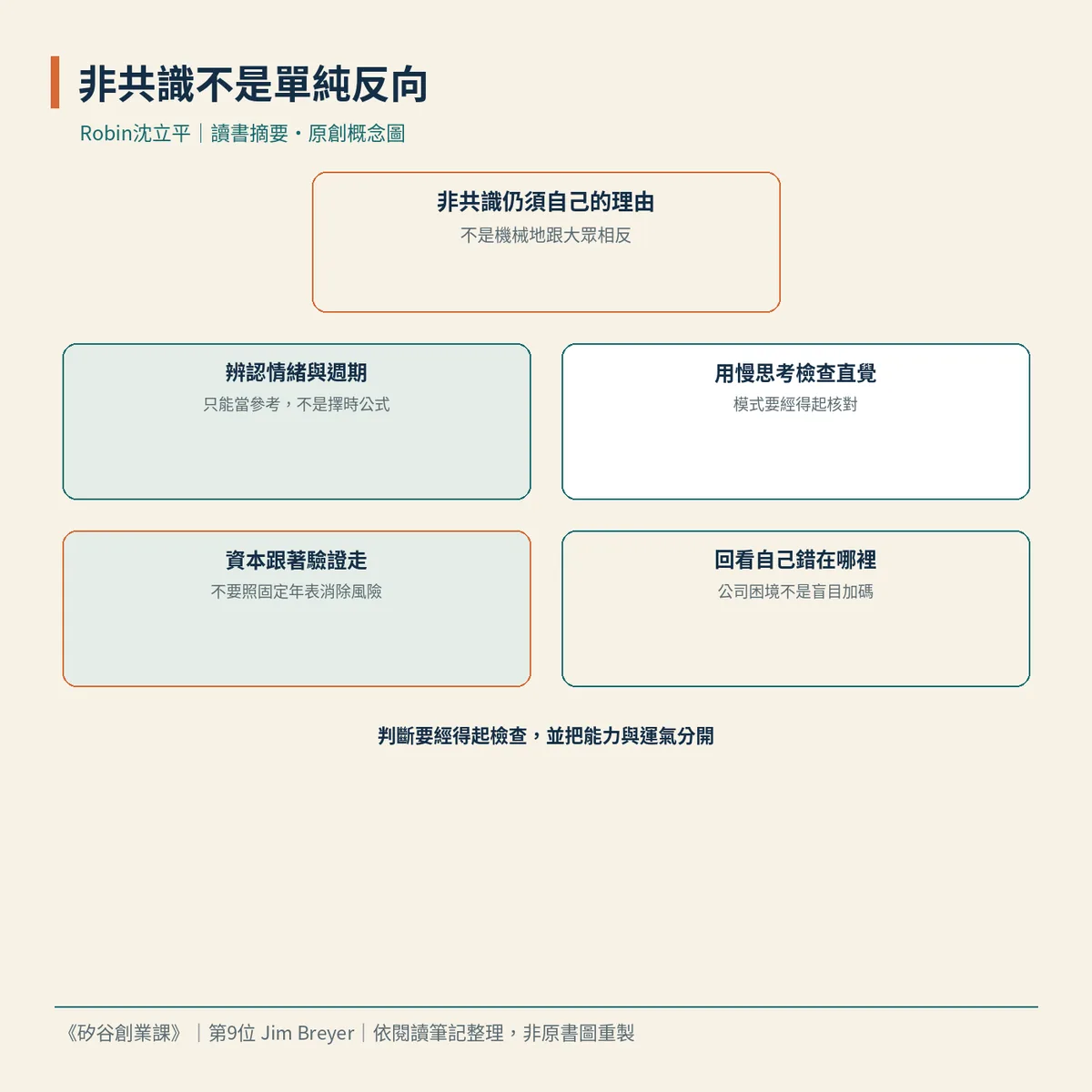
The book identifies Jim Breyer as founder and chief executive officer (CEO) of Breyer Capital and a partner at Accel. Facebook was among his most discussed investments at the time; he also invested in Etsy, Spotify, and others. These descriptions reflect the time when the book was written. His idea of being “nonconsensus” means more than going against the market. It means recognizing emotions and cycles, slowing down to examine intuition, letting capital follow validation, and reviewing mistakes afterward to develop judgment.
Breyer advocates investing faster when market sentiment is depressed and slowing down when it is overly optimistic. The author points out that betting when everyone is panicking is difficult, and emotions often push prices away from value. But contrarian investing needs reasons of its own. It cannot mechanically oppose the crowd at all times. The book also recounts instances when Breyer’s timing was inaccurate. Psychology affects both investment and entrepreneurial decisions, making it even more important to practice two levels of thinking: one fast, based on intuition and existing patterns; the other slower, requiring deliberate reasoning. Citing Daniel Kahneman, the author explains that experience can still help recognize patterns, but intuition should not become the conclusion directly. Check it through slower examination.
Cycles, too, are only a reference, rather than a formula for precise market timing. People want to know where they are in a cycle and use historical experience to identify turning points, but short-term timing is hard to predict accurately. The cadence of capital is also part of judgment. Breyer cautions that too much capital is sometimes more dangerous than too little. The author relays an approach that eliminates technology, sales, and listing risks sequentially by year, then immediately notes that real companies do not eliminate risks on a fixed annual schedule. Excess funding can go toward the wrong expansion and raise the bar for later rounds; insufficient funding creates another kind of pressure. The point is to align capital with what has and has not been validated, rather than follow a table. When seeking companies with unique insights, you likewise need to explain why you see them that way, how they will grow, and be willing to wait. Simply opposing the market cannot replace research.
When a company struggles, the board may face a very difficult day together. The author writes that many companies later regarded as successes nearly failed during their first few months or years. Experienced investors do not immediately give up after one decline, but they still need to judge when to continue support and when to stop. Luck helps, but it cannot sustain this work over the long term on its own. Denying luck is unwise; attributing everything to luck equally fails to improve the next judgment.
The conclusion: for a nonconsensus view to become judgment, it must withstand scrutiny against market sentiment, position in the cycle, and slow thinking, as well as review afterward. Capital should follow validation, rather than a schedule for eliminating risk. When a company struggles, both support and withdrawal need reasons, and skill must be distinguished from luck.
One deeper insight
I think people often encourage themselves by saying “we think differently from everyone else.” It is more useful to write down exactly what is different, how current market sentiment may affect that judgment, and which sign would appear first if we were proved wrong. If you can explain these, contrarian thinking looks more like insight. If you cannot, it is mostly emotional opposition.
Three suggestions
First, for an opportunity you are examining, write down whether the market is currently optimistic or cautious, how your view differs from the majority, and which reasons still hold after slower scrutiny. If all that remains is “because everyone else is wrong,” do not turn it into a decision yet.
Second, compare your capital plan against what has and has not been validated. What should the next funding prove, and what should it avoid scaling prematurely? Do not use a ready-made table that eliminates risks by year, or assume spending can accelerate simply because cash remains in the bank.
Third, if you participate in board work or investment decisions and a company is clearly struggling, first write down what changes you need to see to continue support and which boundary would trigger withdrawal. Separately record which aspects of the difficulty look like execution problems and which look more like timing or luck.
#ADozenLessonsForEntrepreneurs #JimBreyer #ReadingNotes
These are reading notes and reflections based on my personal understanding. I recommend reading them alongside the original book for the full context.
Comments
What do you think? Share your experience or questions.
Sign in to comment, reply or like. Sign in / Sign up
Loading comments…