Note 11 | Ideas Need Execution, and a Mission Needs Product and Talent to Carry It Forward
These are Robin Shen’s original reading notes and commentary, written in his own words after reading Tren Griffin’s A Dozen Lessons for Entrepreneurs. They are not the original book, excerpts from it, or an official publication. Methods and concepts from the book are attributed to Tren Griffin; other sources are identified where stated. For reference only; not investment advice.
English translation of Robin’s Chinese reading notes and commentary. Passages are paraphrased, not verified verbatim quotations from the original English edition.
A Dozen Lessons for Entrepreneurs — Chapter 11, “John Doerr: Kleiner Perkins Caufield & Byers” (Part II, “The Venture Capitalists”)
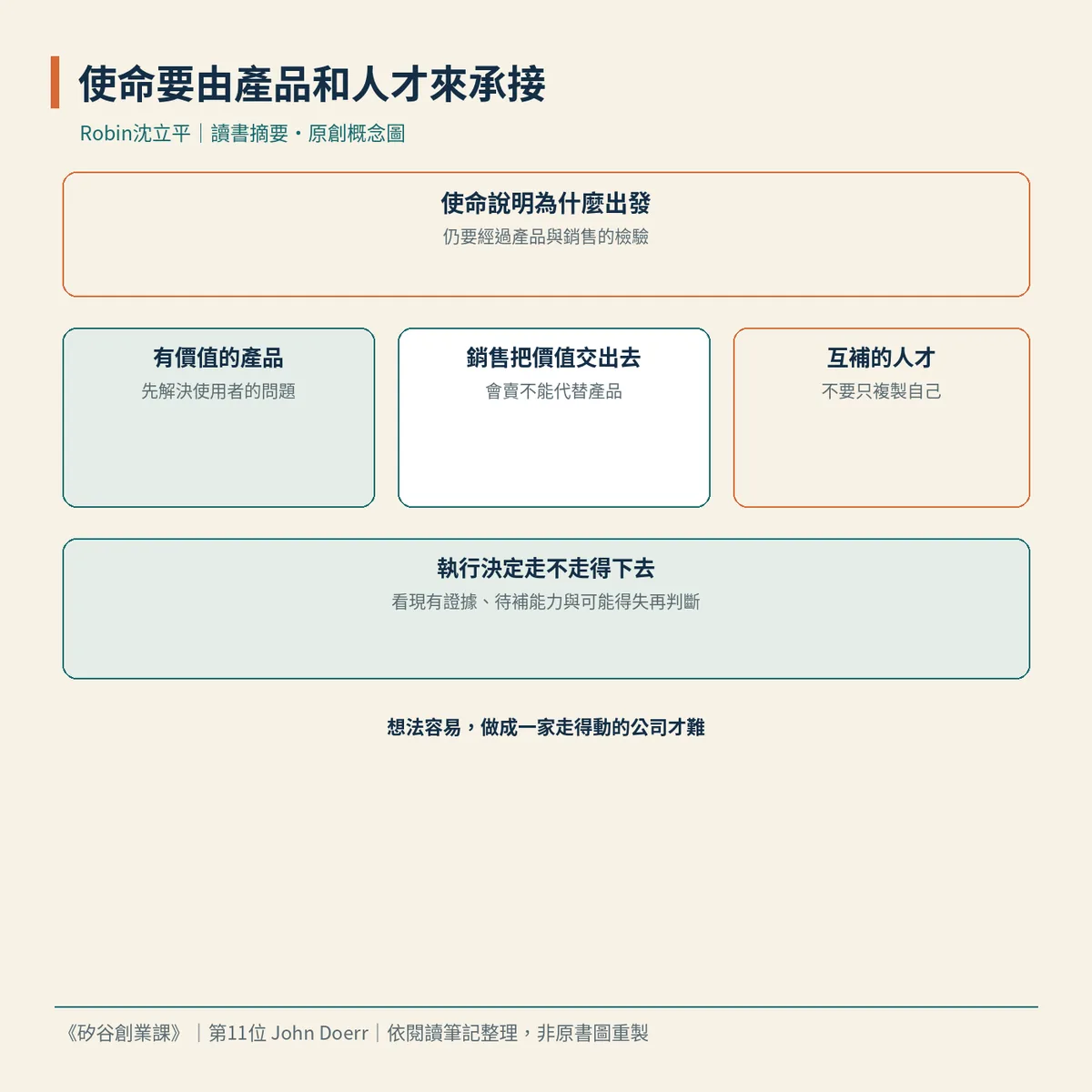
The book identifies John Doerr as a partner and president of Kleiner Perkins Caufield & Byers (KPCB), roles reflecting the time when it was written. He repeatedly shifts the focus from having an idea to being able to execute. For a mission to become a lasting company, it needs a product that solves real problems, sales that puts that value into users’ hands, and people whose capabilities complement one another.
Doerr says a good idea or invention is still not enough for success. Turning a concept into a scalable, sustainable business takes a team to execute it. The author also describes sales as respected work that sometimes determines whether a company survives, adding that he has seen both extremes. All-engineering teams with no one who understands sales often fare poorly. Teams with strong sales but products that cannot solve real problems eventually lose customers. The sensible sequence is to build a genuinely compelling product that solves users’ problems, then invest in marketing and sales. Being able to sell does not mean the product already has value. Only then does the mission have something to stand on. Doerr believes top entrepreneurs do not seek only “success” itself; they want to accomplish something meaningful for users. The author contrasts two starting points: one focused on short-term financial results on paper and competitors, the other on users and long-term contribution. The latter often makes it easier to persist through difficulty, but the mission still has to pass the tests of product and sales to become more than a slogan.
Making these things happen often comes down to people. Doerr says worthwhile endeavors require teams, and good entrepreneurs keep learning and grow alongside their companies. The author explains that leaders should fill in the capabilities they lack rather than simply replicate themselves. Communication, early problem detection, hiring, and enabling people with different specialties to amplify results together all matter more than going it alone. The author’s observation at the time was that technology, entrepreneurs, and capital were not the scarcest resources. Good teams were truly hard to find. Investment judgment can be examined along the same lines. Doerr advocates making a strong bet when the timing is right. The author connects this to opportunities with potentially large upside and relatively limited risk. Rather than betting heavily every time, first think through the odds and the magnitude of the consequences, then decide whether to commit decisively. This helps balance waiting and acting. Whether to invest now should still depend on current product and team evidence, the capabilities still missing, and the possible returns and losses.
The conclusion: mission explains why a company exists; execution determines whether it can keep going. First make the product worthwhile to users, then use sales to deliver it, and find people with complementary capabilities to do the work together. You can act decisively when opportunity appears, but assess current product and team evidence, missing capabilities, and potential returns and losses together. Do not rely solely on the belief that a few outcomes will be exceptionally large.
One deeper insight
I think a mission is easy to make moving on paper. What is often missing is the people and methods to carry it forward: Who makes the product something people want to use? Who takes responsibility for selling it? Who raises objections in the founder’s blind spots? Leave these three roles unfilled, and even a grand mission remains a wish that has yet to be executed.
Three suggestions
First, write one page describing whose problem the mission seeks to solve and how the current product demonstrates that it delivers for users. If you have only a vision and no observable product evidence, strengthen validation before increasing sales efforts.
Second, check whether product, sales, and other essential capabilities complement one another within the team, rather than everyone sharing the founder’s expertise. Write down how you intend to fill the gap, including hiring, dividing responsibilities, or asking someone to offer a different view regularly.
Third, if you are considering a larger commitment, separately write down current product and team evidence, capabilities still missing, and potential returns and losses. Use those to judge whether committing now is worthwhile.
#ADozenLessonsForEntrepreneurs #JohnDoerr #ReadingNotes
These are reading notes and reflections based on my personal understanding. I recommend reading them alongside the original book for the full context.
Comments
What do you think? Share your experience or questions.
Sign in to comment, reply or like. Sign in / Sign up
Loading comments…