Note 12 | Venture Capital Adds Value by Working Alongside Founders to Clarify Judgment
These are Robin Shen’s original reading notes and commentary, written in his own words after reading Tren Griffin’s A Dozen Lessons for Entrepreneurs. They are not the original book, excerpts from it, or an official publication. Methods and concepts from the book are attributed to Tren Griffin; other sources are identified where stated. For reference only; not investment advice.
English translation of Robin’s Chinese reading notes and commentary. Passages are paraphrased, not verified verbatim quotations from the original English edition.
A Dozen Lessons for Entrepreneurs — Chapter 12, “Peter Fenton: Benchmark” (Part II, “The Venture Capitalists”)
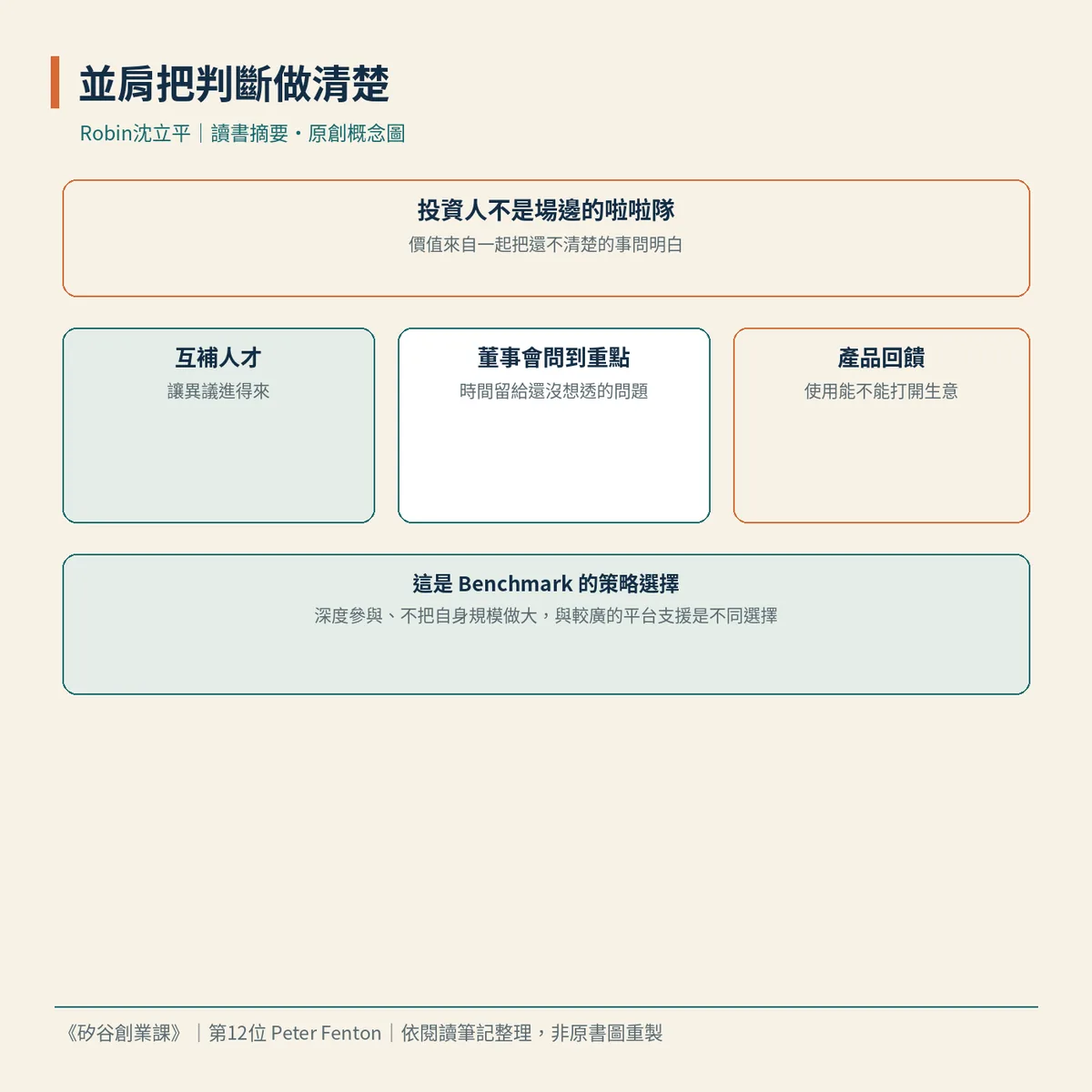
The book identifies Peter Fenton as a partner at Benchmark, following seven years as a partner at Accel. The author describes the fund’s approach as deep involvement without pursuing enormous scale for itself. The value Fenton describes comes from working alongside founders, rather than cheering from the sidelines: complementary talent, pointed boardroom questions, and feedback on whether the product is actually being used all help clarify judgment. This is the way they have chosen to work.
Fenton asks three questions when considering whom to work with: Do they have intrinsic motivation? Can they keep learning? Can they attract excellent people? The author connects these to resilience in adversity, adapting as conditions change, and finding people for something you truly want to build. Founders should likewise choose investors with business capabilities who want to work alongside them, rather than people who only applaud. Everyone has weaknesses, so find complementary partners. Someone strong in technology needs other capabilities alongside them; someone who loves innovation can work with someone who makes daily operations run reliably. The author cautions that if founders surround themselves with people who agree, dissent cannot get through and judgment can narrow.
This depth of collaboration also limits how many companies a fund can serve at once. Fenton says that when deep involvement is required, they prefer to put in more time rather than enlarge the organization and delegate work through additional layers. Partners must personally handle the daily work that needs doing. This approach is difficult to outsource. The author contrasts it with a platform approach, which can use more people to offer broader support in public relations, hiring, or sales. Both models can work. Benchmark’s choice fits its partners’ own working habits. That also explains Fenton’s skepticism toward “raise money first, worry about the product later.” If the relationship is only about capital, this depth of involvement is not a fit. He treats the board as a place for thinking, rather than merely hearing a long series of progress updates. He advocates pointed questions and critical thinking, with concise advance reading prepared when needed so discussion can focus on what remains unresolved. The author adds that if a plan cannot be explained in a few sentences, it often has not been fully thought through.
The product itself is also a source of judgment. Fenton observes that product-driven companies often have more staying power in sales than companies driven only by selling, because users who genuinely find a product useful are more likely to tell others. How a product is used and whether it opens up further business need to work with the business model, each reinforcing the other. Once that feedback forms, it can be powerful, but it is uncommon and cannot be treated as guaranteed in advance. Good judgment is also often learned from earlier misjudgments. Willingness to review what you got wrong and adapt when conditions change matters more than believing you already understand everything.
The conclusion: the value of this approach lies in investors genuinely entering the company’s judgment process: finding complementary people, asking the right boardroom questions, and letting product feedback revise the next step. It suits teams that expect investors to devote time and discuss critical questions closely. Founders who want only a check, or investors who only want to cheer, are pursuing a different path.
One deeper insight
I think founders choosing investors often first ask whether the investor can raise their valuation, and less often whether meetings will expose questions they have not yet thought through. Someone who helps you clarify judgment through questions and someone who only says “you are doing great” provide very different levels of help later.
Three suggestions
First, write down specific things you want an investor to work on with you: finding complementary talent, reviewing product feedback together, or raising particular unresolved questions at board meetings. If the list contains only money and endorsement, reconsider what you want from this partnership.
Second, before the next important discussion, use one page to explain the two or three biggest current uncertainties and the assumptions you have already ruled out. Reserve meeting time for those questions, rather than spending most of it repeating progress that has already happened.
Third, list which parts of the current product users actually use, whether they tell others about it, and whether this reinforces how you currently make money. If the two do not align, first identify whether the product, the way you explain it, or the business model itself needs adjustment.
#ADozenLessonsForEntrepreneurs #PeterFenton #ReadingNotes
These are reading notes and reflections based on my personal understanding. I recommend reading them alongside the original book for the full context.
Comments
What do you think? Share your experience or questions.
Sign in to comment, reply or like. Sign in / Sign up
Loading comments…