Note 17 | A Good Product Also Needs Distribution and a Network That Gives Honest Feedback
These are Robin Shen’s original reading notes and commentary, written in his own words after reading Tren Griffin’s A Dozen Lessons for Entrepreneurs. They are not the original book, excerpts from it, or an official publication. Methods and concepts from the book are attributed to Tren Griffin; other sources are identified where stated. For reference only; not investment advice.
English translation of Robin’s Chinese reading notes and commentary. Passages are paraphrased, not verified verbatim quotations from the original English edition.
A Dozen Lessons for Entrepreneurs — Chapter 17, “Reid Hoffman: Greylock Partners” (Part II, “The Venture Capitalists”)
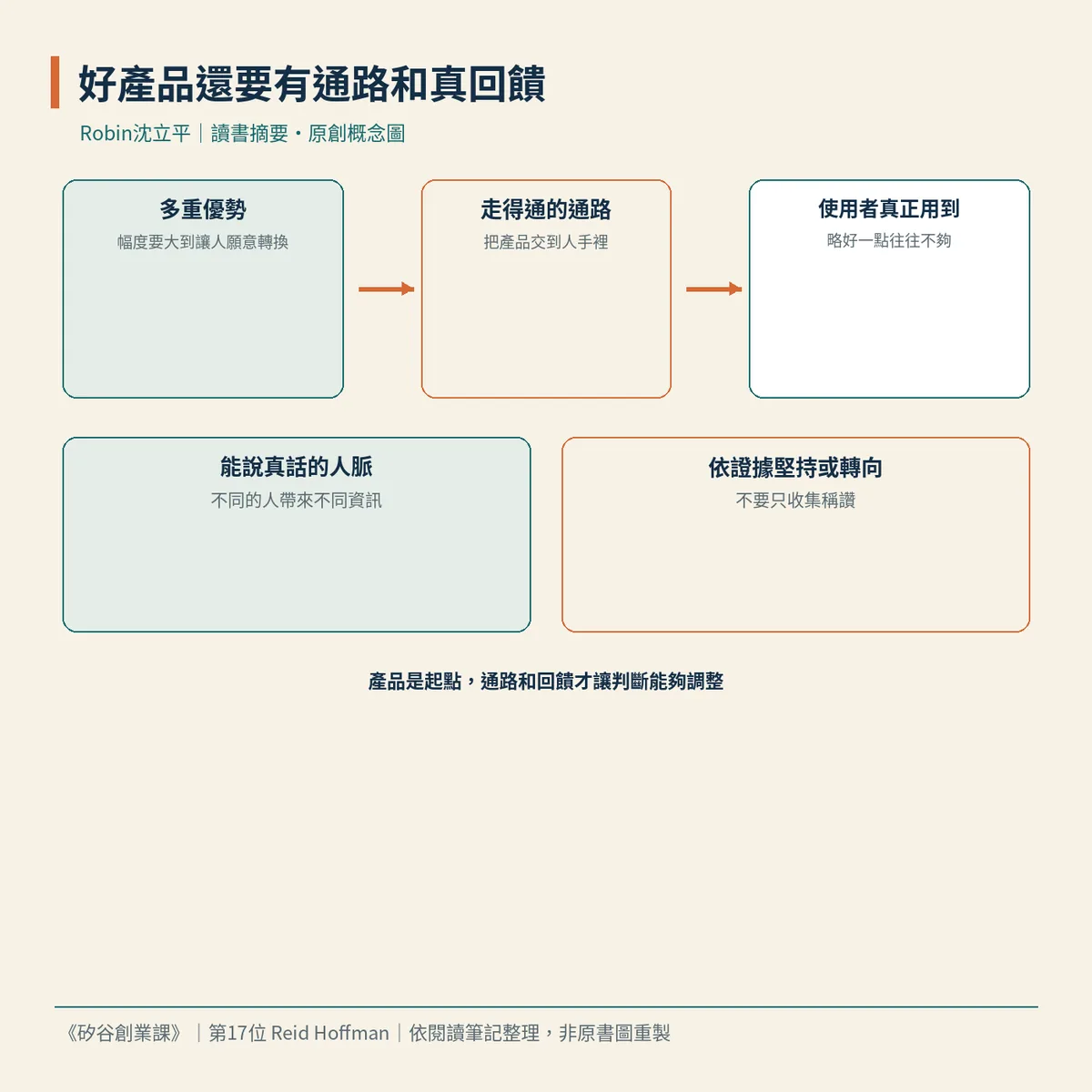
The book describes Reid Hoffman as an entrepreneur, a partner at Greylock Partners, and a cofounder of LinkedIn. When discussing competitive advantage, he goes beyond whether the product is good. He asks whether there are enough advantages and whether they are substantial enough, whether distribution can get the product into users’ hands, and whether people around you will give honest feedback so judgment can adapt to evidence.
Hoffman cautions that slightly better technology or execution is usually insufficient to determine the winner. If competitors have deeply established distribution, ways of spreading the word, or discoverability, even a better product may never reach customers. If a new product is only slightly better than an existing one, users may not want to switch. Advantages need to be multiple and substantial. Even a product that works may not survive without complete distribution. Entrepreneurs must build distribution themselves or find people who truly understand it to help. They cannot expect users to arrive automatically. Getting a product into enough people’s hands is itself part of product strategy. The book presents a view from the time that software delivered over the internet more often drives the large returns venture capital seeks. Some even called Silicon Valley “Software Valley.” This was the book’s assessment of the industry at the time. Even within that argument, distribution and feedback remained necessary.
Get the product out early to obtain real feedback. Hoffman says that if you feel no anxiety at launch, you may already be too late. The author recommends directly asking advisers, colleagues, users, and trusted people whether the plan is good and where the risks lie, rather than collecting only praise. If most people immediately call it genius, the idea may be too ordinary. Useful feedback can improve the product, attract talent, and help a company know whether to persist or adjust. Ideas themselves do not need excessive secrecy. What actually improves the chances is taking action, gathering resources, and letting different people bring unfinished ideas together and gradually make them real. Different people hold different information, and supporters connect to different circles. Broadening feedback sources makes it easier to see risks and opportunities you have not encountered. Listening only to the same people who already agree can make judgment self-reinforcing. There is no fixed formula for persisting with a vision versus pivoting based on new information. An investment thesis combines assumptions and external observations; the strength of evidence changes confidence. The challenge is judging when to continue and when to change.
The conclusion: a good product is a starting point, rather than the whole picture. You need sufficient advantages, workable distribution, and a network willing to speak honestly so you can make corrections soon after launch. Feedback from people and data is a way to turn judgment into action. Both persistence and pivots should follow that evidence.
One deeper insight
I think product discussions often stop at “Are we a little better than existing solutions?” Better questions are whether that improvement is enough to make people switch and which route will get them to actually use the product. Until that route is clear, even numerous advantages exist only in the presentation.
Three suggestions
First, list several advantages you believe you have, and assess whether each is substantial enough to make target users switch. If it is only “a little better,” consider what other advantage is missing or how people could clearly feel that benefit.
Second, describe the specific distribution route that will put the product into users’ hands: who encounters it first, which people or channels it must pass through, and where even an excellent product would get stuck without that route. If you cannot describe it, strengthen distribution before increasing development.
Third, find several people who will speak honestly and ask them to point out risks and confusing aspects before the next launch or experiment. Write down beforehand “What feedback would make us persist, and what would make us adjust?” Avoid collecting only praise, and avoid changing direction without evidence.
#ADozenLessonsForEntrepreneurs #ReidHoffman #ReadingNotes
These are reading notes and reflections based on my personal understanding. I recommend reading them alongside the original book for the full context.
Comments
What do you think? Share your experience or questions.
Sign in to comment, reply or like. Sign in / Sign up
Loading comments…