Note 18 | A CEO Must See Problems Clearly Amid Chaos and Make Decisions
These are Robin Shen’s original reading notes and commentary, written in his own words after reading Tren Griffin’s A Dozen Lessons for Entrepreneurs. They are not the original book, excerpts from it, or an official publication. Methods and concepts from the book are attributed to Tren Griffin; other sources are identified where stated. For reference only; not investment advice.
English translation of Robin’s Chinese reading notes and commentary. Passages are paraphrased, not verified verbatim quotations from the original English edition.
A Dozen Lessons for Entrepreneurs — Chapter 18, “Ben Horowitz: Andreessen Horowitz” (Part II, “The Venture Capitalists”)
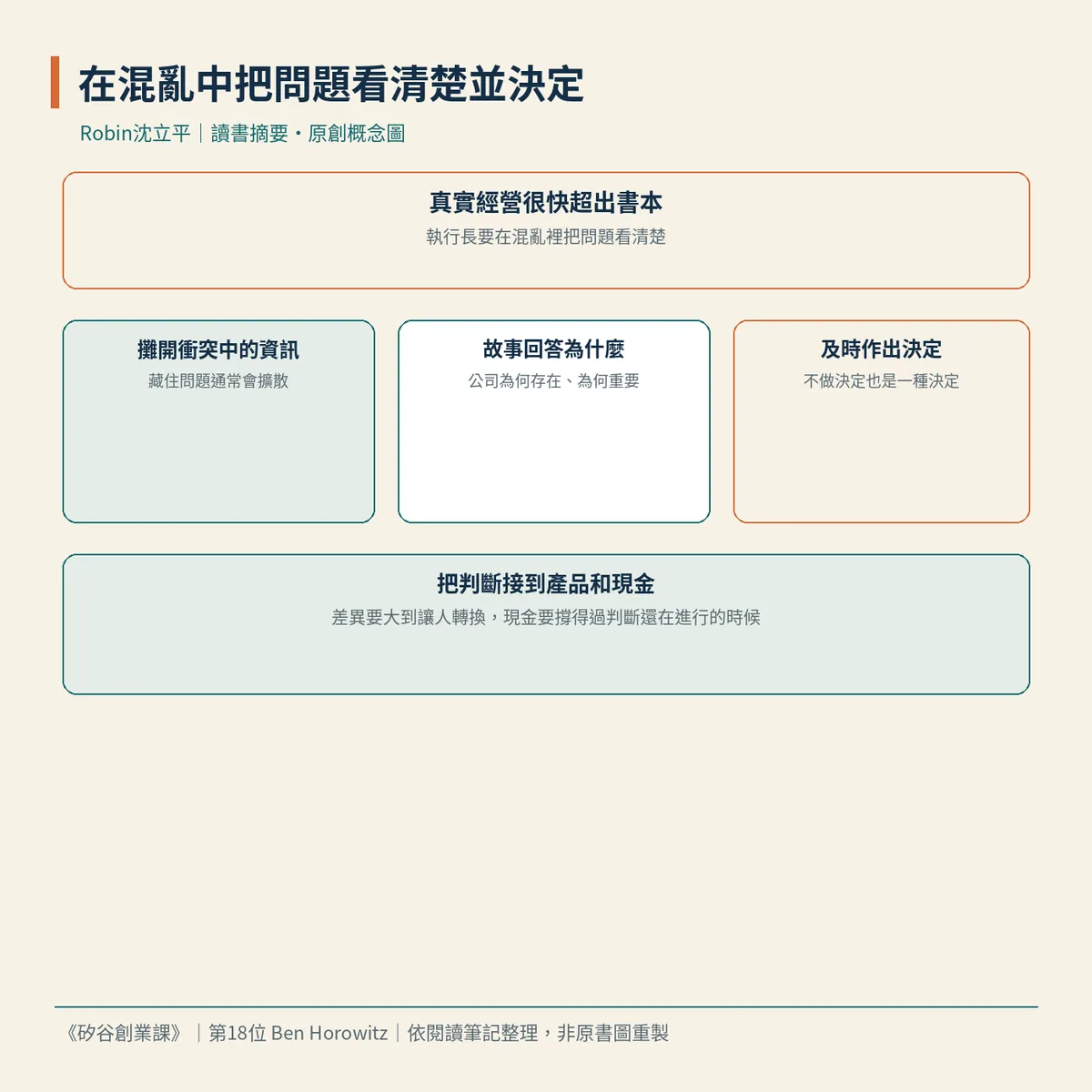
The book identifies Ben Horowitz as a cofounder and general partner of Andreessen Horowitz, following his role as chief executive officer (CEO) of Opsware. His point is not to turn running a company into a manual to copy. It is to recognize that reality quickly exceeds what books can cover. Amid chaos, the CEO must bring conflicting information into the open, explain why the company exists, and understand its operations in ordinary times so decisions can be made promptly when needed. The CEO must also take responsibility for those decisions’ effects on people. Whether the product is strong enough to make people switch, and whether cash remains in the bank, both connect to this work.
Horowitz believes management books may briefly help a new CEO avoid basic mistakes, but actual operations soon exceed their checklists. Management involves context and emotion and is hard to compress into fixed rules. Skills must be learned through actually running a business, and observing others can also help, but simulation cannot be treated as lived experience. When disagreements arise within an organization, he advocates letting everyone explain their views and then addressing the problem, rather than playing peacemaker and suppressing differences. Conflict often points to facts that have not yet become clear. Hiding it usually lets problems spread. Bring information and disagreements into the open for examination so the real problem can be seen.
Strategy must answer “why.” Horowitz says that if employees do not know where the company is going, the problem is often the lack of a story explaining why it exists. A good story must explain why the world needs this company, why it does this work, and why the work matters. This is more than an external message. It helps people inside understand the company’s unique value and where to focus, and can be updated as understanding deepens. In his view, a CEO’s core job is to make sufficiently clear decisions in time, rather than be the company’s best salesperson or product designer. That requires working with finance, engineering, and other roles in ordinary times to understand how the company operates. Otherwise, there is no time to catch up when a crisis arrives. Sometimes the organization does not even need an entirely new plan; it needs a clear explanation of the current situation. Not deciding is itself a decision. These choices affect employees and others involved. Making hard but more correct decisions builds the courage to decide; repeatedly taking the easier but wrong path makes future decisions harder.
Product and cash connect these judgments to everyday work. Horowitz believes a technology startup’s product must clearly outperform existing choices in some respects. Being only a little better is often insufficient to make users switch at scale. The difference must be large enough to motivate switching. Sam Altman also cautions that a better approach is for the product itself to be worth using and talking about, rather than only paying to acquire people. Steve Jobs pointed out that users often do not know what they want until they see it. Horowitz also calls running short of funding a mistake that must not be made. You can spend carefully and discuss dilution, but running out of money leaves earlier judgments with no way to take effect.
The conclusion: a CEO’s job is to see problems clearly amid chaos and make decisions. Bring conflicting information into the open, use a story to explain why the company matters, understand operations in ordinary times, make timely choices when needed, and take responsibility for their consequences for people. The product must be strong enough to make people want to switch, and cash must last through the period when judgments are still being worked through.
One deeper insight
I think the most common response to disagreement within a team is to calm the atmosphere first without putting the facts behind the impasse on the table. When the problem remains unclear, decisions keep getting delayed. By the time a choice becomes unavoidable, there are often fewer options and higher costs.
Three suggestions
First, write down two or three unresolved disagreements within the company or with partners: what facts each side sees and which judgment is blocking progress. First bring the information into the open, then decide how to handle it. Do not put it aside merely to maintain surface agreement.
Second, use one page to answer three questions: Why does the world need this company? Why are we doing this work? Why does it matter now? If the result is only a feature list or competitive slogans, it is not yet a fully thought-through strategy.
Third, examine the next decision you need to make: its current implications for the product, cash, and people involved, and what further delay would cost. Also write down whether the product differs enough from existing choices to make target users switch, and how long cash can sustain the decision-making process.
#ADozenLessonsForEntrepreneurs #BenHorowitz #ReadingNotes
These are reading notes and reflections based on my personal understanding. I recommend reading them alongside the original book for the full context.
Comments
What do you think? Share your experience or questions.
Sign in to comment, reply or like. Sign in / Sign up
Loading comments…