Note 3 | Validate Value Before Growth; Ask Whether It Is Worth Building Before Asking Whether You Can Build It
These are Robin Shen’s original reading notes and commentary, written in his own words after reading Tren Griffin’s A Dozen Lessons for Entrepreneurs. They are not the original book, excerpts from it, or an official publication. Methods and concepts from the book are attributed to Tren Griffin; other sources are identified where stated. For reference only; not investment advice.
English translation of Robin’s Chinese reading notes and commentary. Passages are paraphrased, not verified verbatim quotations from the original English edition.
A Dozen Lessons for Entrepreneurs — Chapter 3, “Eric Ries” (Part I, “The Founder Coaches”)
The book introduces Eric Ries as an entrepreneur, teacher, and author of The Lean Startup who draws on his own entrepreneurial experience to guide founders. Ries argues that you should first ask whether a product should be built and can become a sustainable business, then whether it is technically feasible. Validate that it delivers real value to users before validating how more people will discover it.
Ries describes a minimum viable product (MVP) as a product containing only the necessary attributes that can be put in users’ hands to obtain payment or feedback. As long as feedback is possible, other features can wait. The author explains that an MVP tests assumptions faster and at lower cost. Feedback is the core, rather than treating “minimum” as a scaled-down finished product. Testing still needs boundaries: the experiment design should specify which essential safety requirements and basic quality standards must remain, and which features can be deferred.
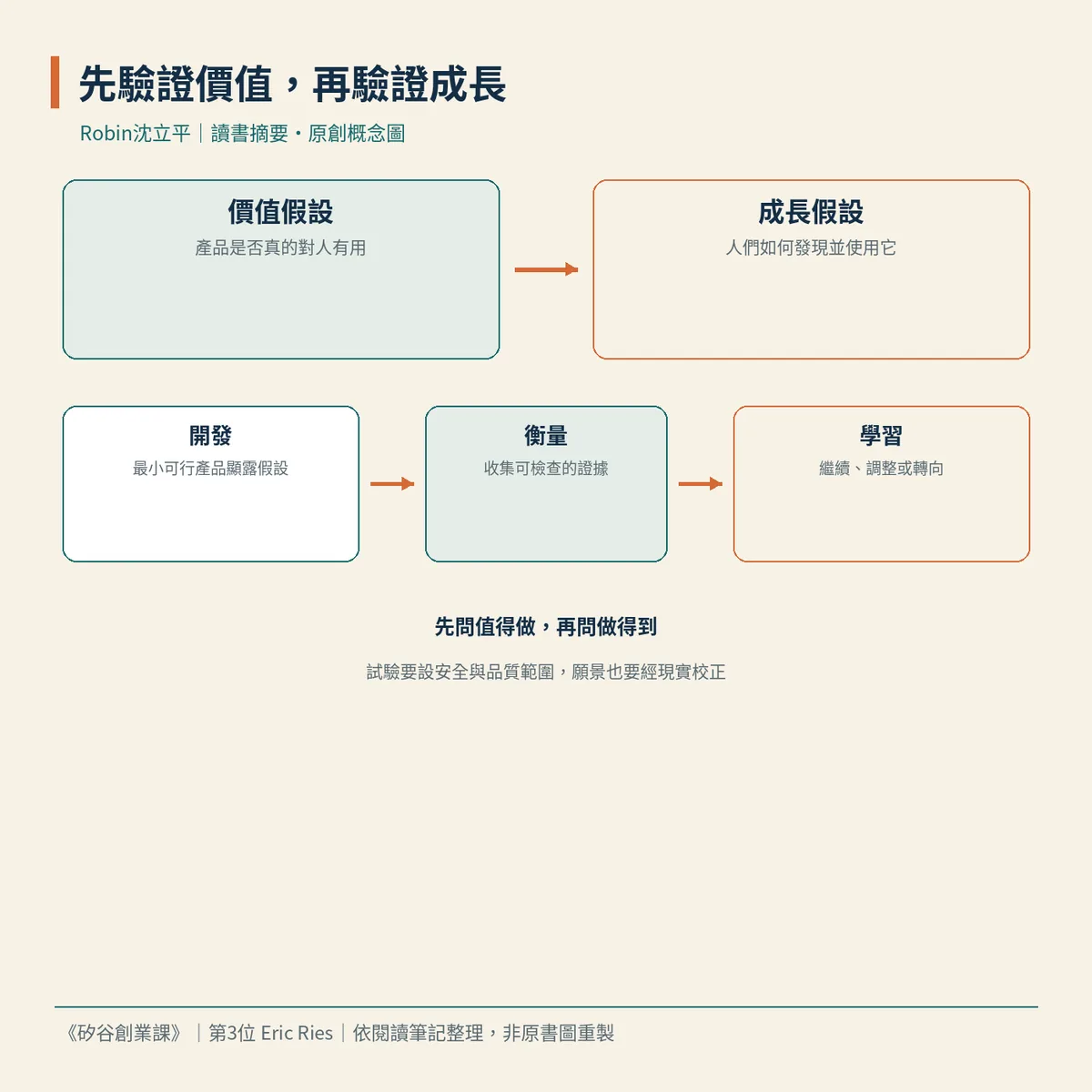
Ask “Should we build it?” before “Can we build it?” The author compares early product development to experimentation and describes the recurring process as “Build-Measure-Learn.” A failed hypothesis also provides information. Actions in product development and marketing can all be designed as experiments: a change, a conversation with a user, or a promotion. If you decide in advance what you are testing, you can learn more with fewer resources. The point is to learn from hypotheses and evidence, rather than treat a single intuition as fact.
Within this loop, two hypotheses need to be examined separately. Ries proposes the value hypothesis and the growth hypothesis: the former tests whether a product delivers real value to users; the latter tests how people discover the product or service. Andy Rachleff further explains the sequence: first identify what value drives usage and which users it serves, then test acquisition paths that can scale. The author adds that organic growth without heavy marketing spending may signal that people see the value. Confirm value first, then validate growth. The decision to persevere or pivot must also rest on evidence. Ries describes three steps: use an MVP to expose current assumptions, run repeated experiments with small adjustments, and then assess at a decision point whether to persevere or pivot. A pivot is a change in path based on what you have learned, rather than an arbitrary change of direction.
You do not need perfection early on, but you do need real users involved. Ries cautions against building high expectations for an early version. A more reliable approach is to test first with less attention and within a scope where risks are more manageable, so you get feedback early rather than waiting for a perfect unveiling before allowing people to use it. A vision can motivate action and help people imagine what the world could become. But if you cling to the vision and fail to see the results in front of you, it can also become an obstacle. Entrepreneurs need to see opportunities others overlook and calibrate that imagination through real-world experiments. Existing users sometimes introduce a product they like to new people. That spread comes from experience; it cannot be assumed in advance as a guaranteed customer acquisition method. Products and models are also easier to imitate, so existing advantages must evolve with the market. Validating value first remains the prerequisite for continuing.
The conclusion: validate value before growth, and ask whether something is worth building before asking whether you can build it. The MVP and “Build-Measure-Learn” both exist to put assumptions to the test. Once the evidence is clear, decide whether to persevere, make small adjustments, or pivot. Vision can get people started, but it cannot replace experimentation.
One deeper insight
I think teams most often start by asking “Can we pull this off?” They fill the schedule with features and technical challenges but cannot explain why users would want the product. A more useful starting point is to write down the value hypothesis: who would find this worthwhile, why, and how a small experiment could reveal that.
Three suggestions
First, write the value hypothesis and growth hypothesis separately, listing the evidence you already have and a testing method for each. If evidence of value is still missing, test value first. Use the results to decide whether and when to schedule broader customer acquisition.
Second, define the MVP for your current idea: the safety requirements and basic quality standards that must remain, the features that can wait, and the type of feedback to collect from which users. If you cannot specify how to get feedback, it is not yet a real experiment.
Third, before starting the experiment, write down what would make you persevere, pivot, or stop. At the end of a round, examine the evidence before deciding. Adjust the duration to the product; do not wait until everything is finished to ask whether it should have been built.
#ADozenLessonsForEntrepreneurs #EricRies #BuildMeasureLearn #ReadingNotes
These are reading notes and reflections based on my personal understanding. I recommend reading them alongside the original book for the full context.
Comments
What do you think? Share your experience or questions.
Sign in to comment, reply or like. Sign in / Sign up
Loading comments…