Note 24 | Turn Startup Learning Into a Repeatable System
These are Robin Shen’s original reading notes and commentary, written in his own words after reading Tren Griffin’s A Dozen Lessons for Entrepreneurs. They are not the original book, excerpts from it, or an official publication. Methods and concepts from the book are attributed to Tren Griffin; other sources are identified where stated. For reference only; not investment advice.
English translation of Robin’s Chinese reading notes and commentary. Passages are paraphrased, not verified verbatim quotations from the original English edition.
A Dozen Lessons for Entrepreneurs — Chapter 24, “Jessica Livingston: Y Combinator” (Part II, “The Venture Capitalists”)
The book notes that Jessica Livingston cofounded Y Combinator (YC) with others in March 2005, serves as a partner, and drives its day-to-day operations. She also wrote Founders at Work, a collection of interviews with technology startup founders. These descriptions reflect the time when the book was written. The book describes YC as a large startup incubator. What she and her cofounders eventually built was more than another way to promote a particular viewpoint. They turned the fragmented learning that happens during a startup’s development into a repeatable system.
Livingston says YC’s early experience resembled that of other startups: identify a pain point and believe you can create a useful solution. It initially served programmers, teaching the operating and business knowledge they needed to turn technical ideas into businesses. Low-cost software made small, standardized investments feasible. The founders briefly considered a more dispersed approach like that of other investors. Then, realizing they did not truly understand angel investing, they immediately invested in a few companies to learn. YC wanted to provide a startup’s first funding, enabling more teams to get started, rather than become their only source of capital. A synchronized process also allowed founders in the same cohort to teach one another and compare judgments. The author explains why this peer learning works by noting that, as a student, he often learned more from classmates than from classes. That is the author’s experience, not Livingston’s account of her own life.
She defines the one principle that comes close to a manifesto quite narrowly: make a genuinely useful product that users will like. Without users, a company cannot keep going. If users do not like it, other work will not help. In practice, the journey rarely starts with a perfect idea. Interviewees in Founders at Work and YC founders often try one thing, see users respond better to a particular feature, and shift toward it. The author also writes that most founders he interviewed changed their initial ideas. Mistakes provide information, and people who adapt have a better chance of continuing. YC put repeated tests of value and growth hypotheses into scalable processes and training, so this learning no longer depended solely on individual founders’ intuition.
Making learning systematic does not make the road smoother. Livingston recalls that even YC’s own lawyer discouraged it at the start. Many teams that later gained recognition were also rejected early on. Startups do not follow the plan. Founders face uncertainty, isolation, and stalled progress every day, and new things are often not accepted. Persistence, resilience, and drive help them through that stretch. Yet the media often make successful people’s paths look too smooth, as though the result followed directly from making a commitment. The author cautions that luck matters alongside determination. But the efforts people make to improve their odds generally involve skill. The two should not be collapsed into “It was all luck” or “It was all destined to happen.” Innovations that look inevitable afterward were often experiments whose outcomes were unclear at the time.
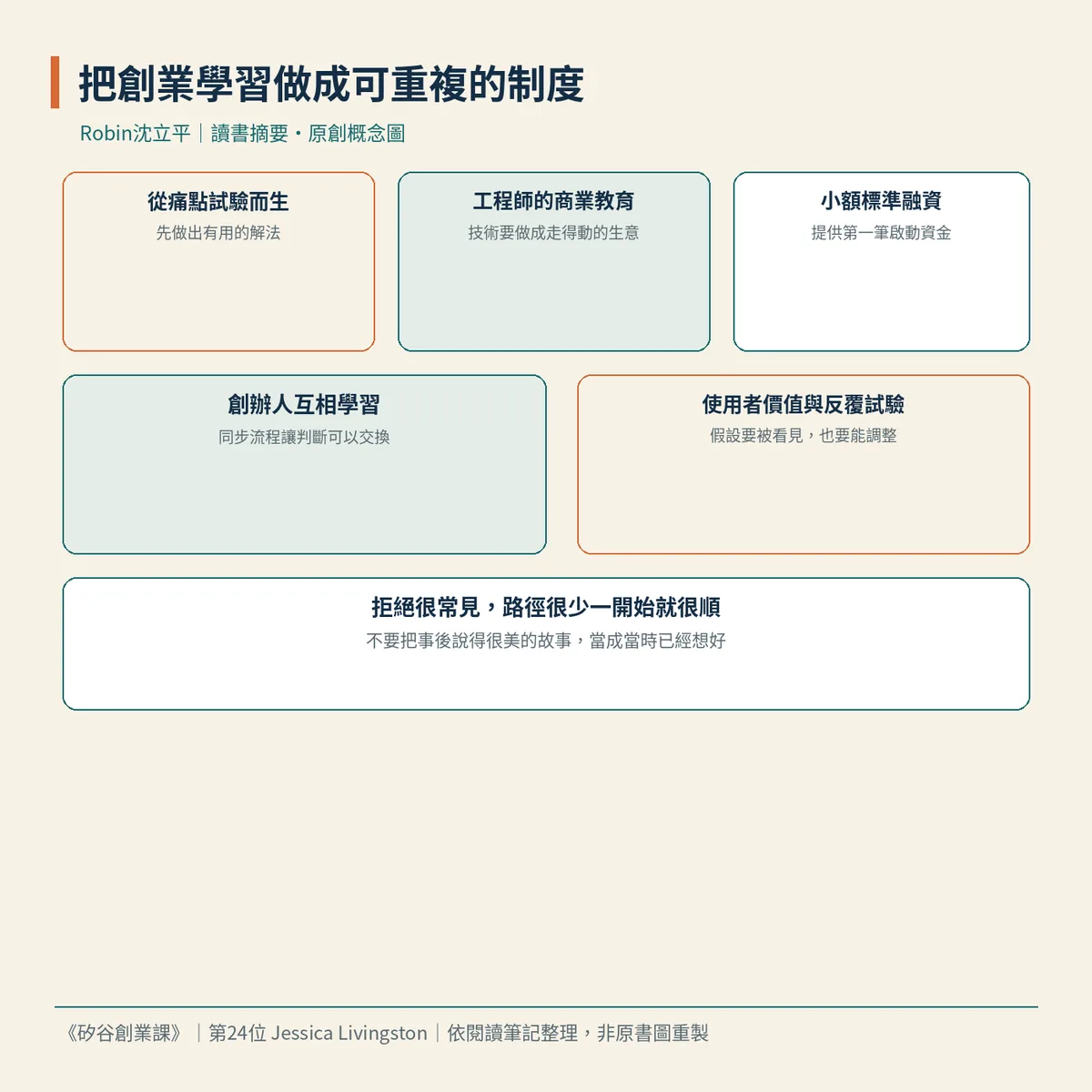
The conclusion: YC made startup learning systematic through experiments rooted in pain points, business education for engineers, small standardized funding, and peer learning among founders. The question to keep checking is whether users find the product useful. Neither rejection nor a story polished in hindsight should obscure the hypotheses revised along the way.
One deeper insight
I think people discussing incubators often first ask which later-stage investors they can introduce. Less often do they ask whether there is a system that lets founders repeatedly test whether users actually like the product, and learn their next steps from peers rather than only from talks. If a system amounts only to procedures and events, learning still will not happen automatically.
Three suggestions
First, write down the value or growth hypothesis you most want to test, whose feedback the next experiment will gather, and what findings would lead you to continue or adjust. If you cannot yet describe an observable outcome, do not treat “We have joined an incubator” as proof that the learning is done.
Second, list who on the team is responsible for turning technology into value users can understand, what business knowledge you most lack, and which peer or kind of experienced practitioner you will ask for advice. If the gap is being filled only by internal guesses, add a source of mutual learning.
Third, revisit the most recent rejection or disruption to your plan. Which hypotheses did you actually change, and which later proved useful? Do not retell the experience as a path you had planned from the outset, or explain the outcome solely through luck or solely through determination.
#ADozenLessonsForEntrepreneurs #JessicaLivingston #ReadingNotes
These are reading notes and reflections based on my personal understanding. I recommend reading them alongside the original book for the full context.
Comments
What do you think? Share your experience or questions.
Sign in to comment, reply or like. Sign in / Sign up
Loading comments…