Note 29 | Market Demand Often Outweighs Self-Confidence; Contrarian Choices Still Need Judgment and Patience
These are Robin Shen’s original reading notes and commentary, written in his own words after reading Tren Griffin’s A Dozen Lessons for Entrepreneurs. They are not the original book, excerpts from it, or an official publication. Methods and concepts from the book are attributed to Tren Griffin; other sources are identified where stated. For reference only; not investment advice.
English translation of Robin’s Chinese reading notes and commentary. Passages are paraphrased, not verified verbatim quotations from the original English edition.
A Dozen Lessons for Entrepreneurs — Chapter 29, “Andy Rachleff: Wealthfront” (Part II, “The Venture Capitalists”)
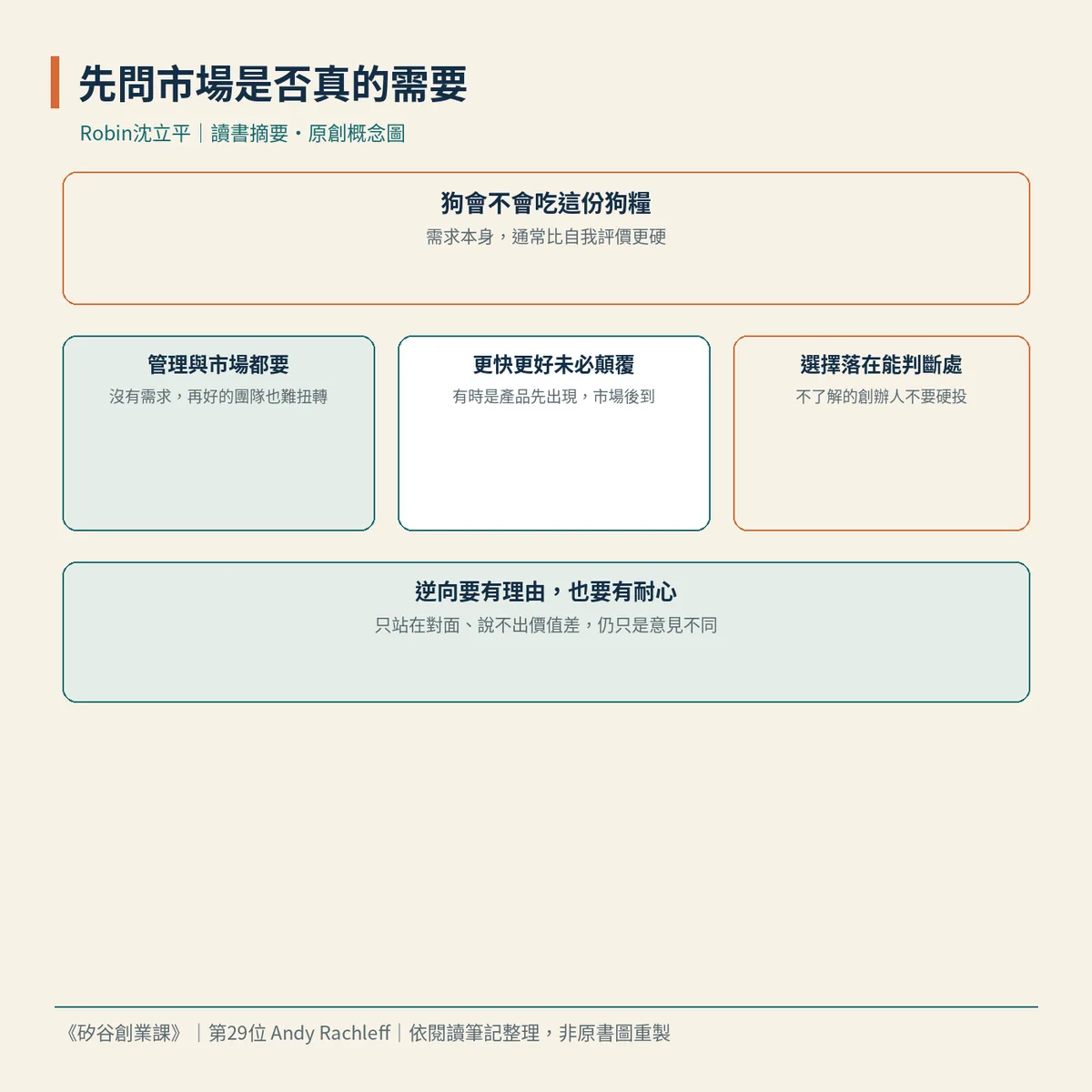
The book describes Andy Rachleff as a former Benchmark partner who later helped found Wealthfront. These descriptions reflect the time when the book was written. He often puts “Will the dogs eat the dog food?” near the top of the discussion. First ask whether the market actually needs the product, rather than how confident entrepreneurs are in themselves. Both a good management team and a good market matter, but demand is usually the less negotiable reality. Successful contrarian investing also requires patience and judgment, not simply taking the opposite side.
Rachleff believes both management and the market are essential, but market demand often outweighs managerial ability. Even an excellent team struggles to turn things around when working in a market without demand. Disruption also takes different forms: some innovations create a new market; others enter through an underserved part of an existing market. Making something faster and better does not automatically make it disruptive. Sometimes the product comes first and the market is found later, even creating new demand along the way. Innovation is difficult. It requires a mission, patience, and an understanding of the field. He also says he will not invest in founders who have no referral or whom he does not understand. Choices should stay within the range where judgment is possible.
Venture capital has cycles, and downturns will come. Turning points are hard to predict, so preparation must happen in advance. For people deciding which company to join, choosing the right company often has more influence on what they will learn than choosing a title or compensation package. Everyone wants returns, yet people are often unwilling to take the corresponding risks. The number of failures matters less than whether the successes are big enough. Large returns usually require both a view that differs from the majority’s and a correct judgment. Taking the opposite side without explaining where the value differs is still just a difference of opinion. Starting with trust and negotiating fairly makes it easier to build a network of lasting relationships. He also discourages joining situations where the money is not really needed and participation merely sustains an insider circle. Relationships should rest on the ability to assess one another and deal fairly.
The conclusion: first ask whether the market truly needs the product, then whether the team can meet that demand. Feeling good about yourself cannot substitute for users’ willingness to adopt. Contrarian choices need reasons and patience, and should stay within what you can genuinely assess.
One deeper insight
I think the easiest thing for a team discussing an idea is to vouch for its own enthusiasm. Less often do they first ask what market evidence remains if we remove the founders’ self-assessment. Without that step, the moat and fundraising story rest on assumptions that no dog has yet taken a bite of.
Three suggestions
First, write down the strongest current evidence that people genuinely need this product, and what remains of the team’s self-assessment without that evidence. If the evidence is insufficient, return to users before strengthening the pitch.
Second, distinguish whether your improvements create new demand or simply make an existing option faster and better. Then write down what kind of patience and domain understanding you still need to keep working in this market.
Third, if you are making a contrarian judgment, list why you differ from the majority, how long it will take to know whether you are right, and whether the judgment falls within what you truly understand. If you cannot state the reasons and conditions for waiting, it is not yet a grounded contrarian choice.
#ADozenLessonsForEntrepreneurs #AndyRachleff #ReadingNotes
These are reading notes and reflections based on my personal understanding. I recommend reading them alongside the original book for the full context.
Comments
What do you think? Share your experience or questions.
Sign in to comment, reply or like. Sign in / Sign up
Loading comments…