Note 30 | Treat a Startup as a Series of Experiments With Capped Losses and Room for Upside
These are Robin Shen’s original reading notes and commentary, written in his own words after reading Tren Griffin’s A Dozen Lessons for Entrepreneurs. They are not the original book, excerpts from it, or an official publication. Methods and concepts from the book are attributed to Tren Griffin; other sources are identified where stated. For reference only; not investment advice.
English translation of Robin’s Chinese reading notes and commentary. Passages are paraphrased, not verified verbatim quotations from the original English edition.
A Dozen Lessons for Entrepreneurs — Chapter 30, “Naval Ravikant: AngelList” (Part II, “The Venture Capitalists”)
The book describes Naval Ravikant as a cofounder of AngelList. This description reflects the time when the book was written. In his view, as the cost of starting a company falls, entrepreneurship becomes more like a series of experiments with manageable losses and remaining upside. Iterate at lower cost, prove value first, then decide how much capital and time to commit.
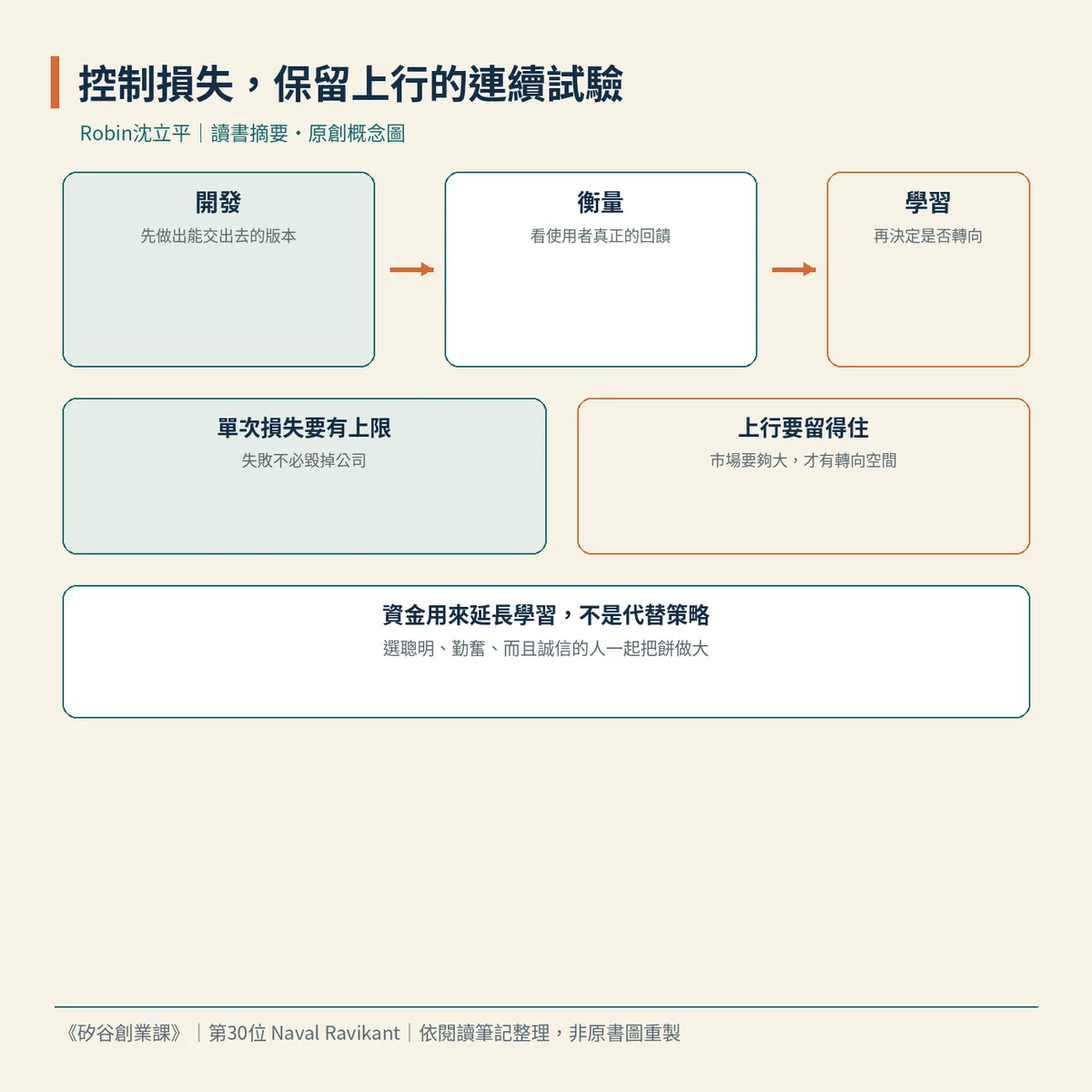
Ravikant says that as the cost of building and launching products falls, repeated experimentation becomes a way to navigate complexity. Even if the chance of success in any single attempt is low, the market becomes more efficient if the cost of failure falls far enough. The process can be expressed as “Build-Measure-Learn”: create a version users can get their hands on, examine the evidence, then adjust. The author connects this to experiments with controlled losses and preserved upside. A single failure need not destroy the company, but when upside appears, there must be room to scale it. Network effects and concentrated returns create widely divergent outcomes. Those who reach product-market fit first often have an advantage, so speed and agility matter. The market also needs to be large enough. Entrepreneurs are unlikely to get things right at the outset and need room to pivot.
The amount of capital must suit this experimental approach. An oversized seed round can sometimes distort both pricing and pace, making unproven work expensive. Building a large company often takes about as much effort as building a small one. That makes it more important to compare expected value rather than just ask whether you can build something big. In choosing a team, he looks for intelligence, hard work, and integrity, considering integrity the hardest to replace. Companies often fail because founders give up or money runs out. Funding provides options, but day-to-day operations still need to be frugal. Raising a little more money and keeping spending under control are compatible, provided the money extends the runway for learning rather than substitutes for an unclear strategy. He also cautions that startups need to focus on micro-level unit economics. Macroeconomic discussions do not solve product and customer problems. Finally, growing the pie matters more than fighting over what already exists. Work with people genuinely willing to act.
The conclusion: treat a startup as a series of experiments, cap the loss on each attempt, and preserve the upside. Prove value through “Build-Measure-Learn,” choose a market large enough, and secure enough funding without letting it distort the pace. Then build with people who are intelligent, hardworking, and have integrity.
One deeper insight
I think fundraising discussions easily become “Taking a little more will make us safer.” The better question is whether the extra money lets us finish the next experiment or delays our confrontation with unproven assumptions. If losses are uncapped and learning has stopped, the options have already been spent.
Three suggestions
First, write down the most you could lose in the current experiment, what the upside would be if it succeeds, and whose feedback you need next in “Build-Measure-Learn.” If you cannot state a loss limit, the experiment is not yet under control.
Second, check whether the market is large enough to allow a pivot and whether current funding extends learning or prematurely locks in an unproven pace. If it is the latter, write down which spending you will pull back and whether validation would genuinely stop without it.
Third, list the observable evidence of intelligence, hard work, and integrity in the core team. If integrity is only a self-description, add observable examples, and describe the kind of people who are truly willing to act that you want as collaborators.
#ADozenLessonsForEntrepreneurs #NavalRavikant #ReadingNotes
These are reading notes and reflections based on my personal understanding. I recommend reading them alongside the original book for the full context.
Comments
What do you think? Share your experience or questions.
Sign in to comment, reply or like. Sign in / Sign up
Loading comments…