Note 4 | Start With a Mission, Then Test the Idea Through Product and Execution
These are Robin Shen’s original reading notes and commentary, written in his own words after reading Tren Griffin’s A Dozen Lessons for Entrepreneurs. They are not the original book, excerpts from it, or an official publication. Methods and concepts from the book are attributed to Tren Griffin; other sources are identified where stated. For reference only; not investment advice.
English translation of Robin’s Chinese reading notes and commentary. Passages are paraphrased, not verified verbatim quotations from the original English edition.
A Dozen Lessons for Entrepreneurs — Chapter 4, “Sam Altman: Y Combinator” (Part II, “The Venture Capitalists”)
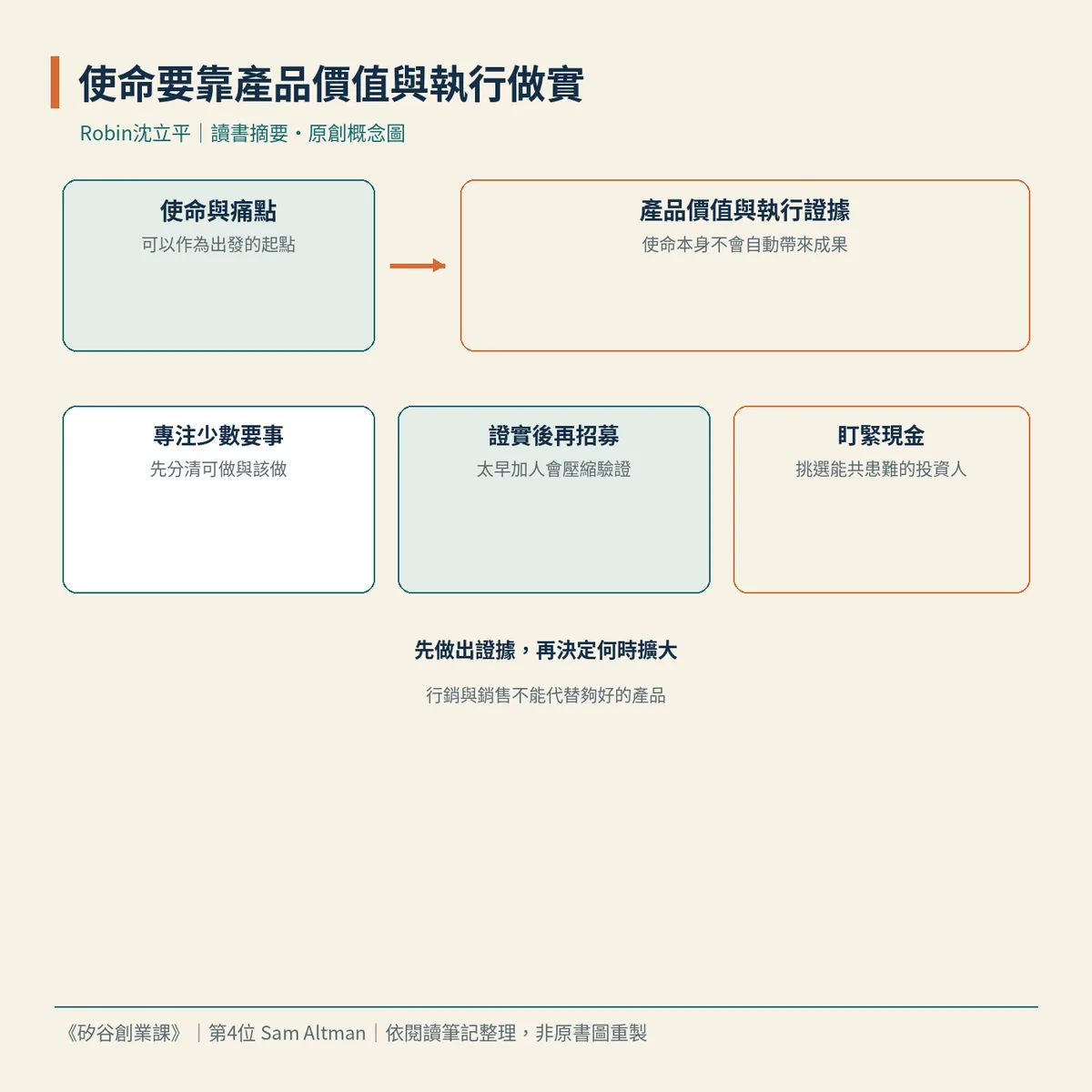
The book introduces Sam Altman as president of Y Combinator (YC) and cofounder and chief executive officer (CEO) of Loopt. YC invested in Loopt in 2005. These roles reflect the time when the book was written. A mission and a pain point you have experienced can be starting points, but evidence of product value and execution must make them real. Then decide whether to expand hiring and how long your cash will last.
Altman believes good companies are often mission-driven. The author explains that a mission makes founders willing to commit and stay through adversity. Building a scalable, repeatable business that can withstand competition is uncommon to begin with. But a mission does not automatically produce results. Altman also cautions that it is best to build a product or service you truly need yourself. Understanding a problem mainly through secondhand accounts, without ever encountering it yourself, is often not deep enough. Personal pain points are useful starting points, as is expertise in the relevant field. You still need to check with users, but you should make the problem concrete from the outset.
Next, growth tactics cannot replace the product itself. Altman says that without a sufficiently good product, even the strongest marketing plan or sales team cannot keep a company alive over the long term. The author connects this to word of mouth and organic growth. A company needs to offer something people want to recommend, rather than sustain appearances by driving customer acquisition costs ever higher. Execution is also more important than the idea, and harder. The point is to deliver an experience users find worthwhile and spend time on the few things that truly matter. Distinguish what you can do from what you should do. Focus effort on critical work such as whether the product delivers for users, so secondary activities do not take resources away from execution.
This directly affects hiring and cash. Altman argues that startups should avoid hiring too early. Expand the team when there is a real need and the value hypothesis has been validated. The author explains that while value remains unproven, a small team is more efficient and burns less cash, preserving more time for validation. Expanding too early can create cost pressure that pushes an untested product into the market. Watch cash just as closely: track how long it will last, and do not run out. When choosing investors, the author recommends asking other founders how those investors behaved when their companies struggled. A few people who participate meaningfully and can help with hiring or distribution are often more useful than a long list of minimally involved investors.
The conclusion: mission and pain points explain why you started, but they cannot replace evidence that the product has real value and that execution can keep up. Establish evidence of both first. Then decide which work deserves focus, when to hire, and how to manage cash and investors.
One deeper insight
I think the easiest trap for a team is to write a moving mission statement while its calendar fills up with secondary activities. A more useful check is whether this week’s work is actually testing whether users find the product worthwhile. If the answer is unclear, do not use hiring and exposure to create a feeling of progress.
Three suggestions
First, write a paragraph describing the company’s mission and the problem you personally experienced that it comes from. Alongside it, add “What would show that users also find this valuable?” Then write down the evidence you already have or the test you need to run next.
Second, divide current work into two columns. One covers validating product value or critical execution; the other covers expanding customer acquisition, hiring, or other extensions. While value remains unclear, reclaim time to strengthen the first column before scheduling work to expand the second.
Third, write down roughly how long current cash can sustain the company, what evidence you need before next considering new hires, and, if you plan to accept investment, which founders you will ask about how that investor behaved when their companies struggled.
#ADozenLessonsForEntrepreneurs #SamAltman #ProductValue #ReadingNotes
These are reading notes and reflections based on my personal understanding. I recommend reading them alongside the original book for the full context.
Comments
What do you think? Share your experience or questions.
Sign in to comment, reply or like. Sign in / Sign up
Loading comments…