Note 35 | Connect Invention, Product, Users, and Market Into a Lasting Business
These are Robin Shen’s original reading notes and commentary, written in his own words after reading Tren Griffin’s A Dozen Lessons for Entrepreneurs. They are not the original book, excerpts from it, or an official publication. Methods and concepts from the book are attributed to Tren Griffin; other sources are identified where stated. For reference only; not investment advice.
English translation of Robin’s Chinese reading notes and commentary. Passages are paraphrased, not verified verbatim quotations from the original English edition.
A Dozen Lessons for Entrepreneurs — Chapter 35, “Ann Winblad: Hummer Winblad Venture Partners” (Part II, “The Venture Capitalists”)
The book describes Ann Winblad as a venture investor at Hummer Winblad Venture Partners (HWVP), with a background as a software entrepreneur. These descriptions reflect the time when the book was written. She focuses her investments on software, not because invention itself equals success, but to connect technology, products, users, and a sufficiently large market into a business that can endure and keep generating returns. This is her choice of specialization.
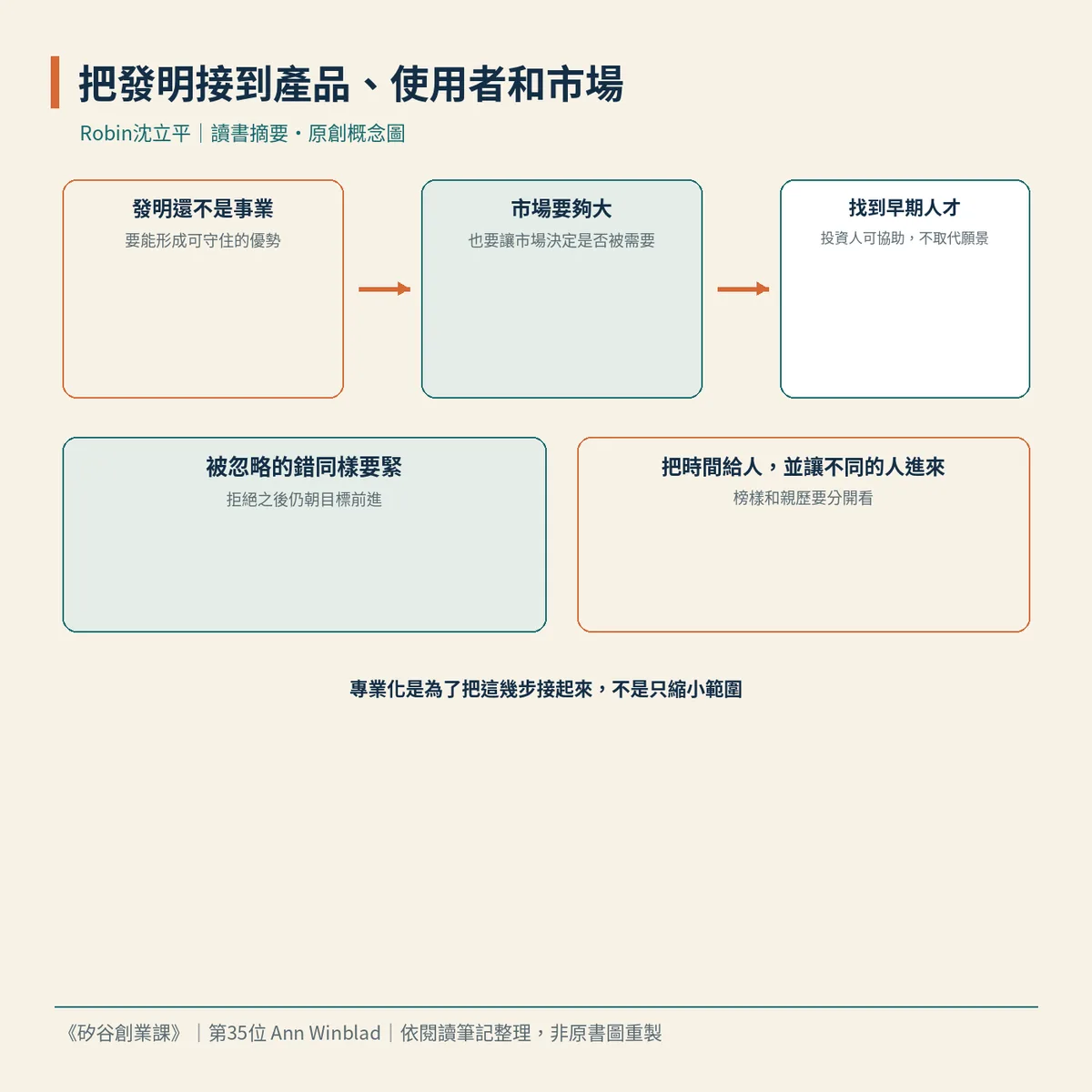
Winblad cautions that an invention does not by itself mean a startup has succeeded. The product and technology need to create a defensible advantage. It is also important to ask first whether the market opportunity is large enough, and only then judge the quality of the team or technology. The market determines whether the product is genuinely needed; founders must be able to recruit critical early people. She distinguishes clearly between investors and founders: investors often start from an opportunity, while founders bring a dream to life. Investors can help recruit but cannot replace the founder’s vision. With limited resources, startups especially need leverage while also considering how to build the company. Facing risks you cannot yet know, do not freeze in fear; put your judgment into practice.
In assessing teams, she uses both pattern recognition and concrete indicators, and chooses people with complementary backgrounds. With risks that remain unclear, judgment requires practice rather than waiting for fear to disappear. Errors of omission can sometimes be as significant as mistakes already made. Missed opportunities can also become real future costs. Even after repeated fundraising rejections, founders must retain the optimism to move toward their goals. The book records that she held a large number of meetings for her first funding commitment before the first backer finally agreed to join. This was her own path. It illustrates the importance of focus and persistence, not a meeting-count template to copy.
When discussing time, gratitude, and opening doors to people from different backgrounds, Winblad mentions Mary Gates. The author then writes in the first person about his own relationships with the Gates family and what they taught him about time and reciprocity. That firsthand experience belongs to Griffin, not Winblad, and certainly not the reader. Keeping the accounts separate makes two things clearer: how role models become visible, and how reciprocity and giving time to others are practiced from different positions.
The conclusion: specialization connects invention to products, users, and a sufficiently large market, making advantages defensible and helping fill out the team. Investors can help find people, but cannot choose the destination for the founder. Rejection and missed opportunities both happen. Focusing time on the goal and welcoming different people are ways to keep building the business.
One deeper insight
I think technical discussions easily stop at “Here is what we built.” Less often do they go on to ask whether the market is large enough, whether users truly need it, and whether the founder can recruit those first few people. If invention does not connect to those three steps, specialization has merely narrowed the field of view. It has not yet put the business together.
Three suggestions
First, write down how the current invention or technology becomes a product users need, how its advantage will be defended, and why the market is large enough. If any answer relies only on a vision, add evidence before discussing expansion.
Second, list the key early people the founder is recruiting, where investors can help, and which decisions about the vision must remain the founder’s. If the help is described as “choosing the direction for the founder,” it has already crossed a boundary.
Third, revisit the latest rejection or judgment that nearly went unexamined. Could it matter as much as a mistake already made? Also write down whom you will give time to, whom you should thank, and what different kind of background the team still lacks.
#ADozenLessonsForEntrepreneurs #AnnWinblad #ReadingNotes
These are reading notes and reflections based on my personal understanding. I recommend reading them alongside the original book for the full context.
Comments
What do you think? Share your experience or questions.
Sign in to comment, reply or like. Sign in / Sign up
Loading comments…