Conclusion | Venture Capital Is a Service Business: Help Companies Grow Through Judgment
These are Robin Shen’s original reading notes and commentary, written in his own words after reading Tren Griffin’s A Dozen Lessons for Entrepreneurs. They are not the original book, excerpts from it, or an official publication. Methods and concepts from the book are attributed to Tren Griffin; other sources are identified where stated. For reference only; not investment advice.
English translation of Robin’s Chinese reading notes and commentary. Passages are paraphrased, not verified verbatim quotations from the original English edition.
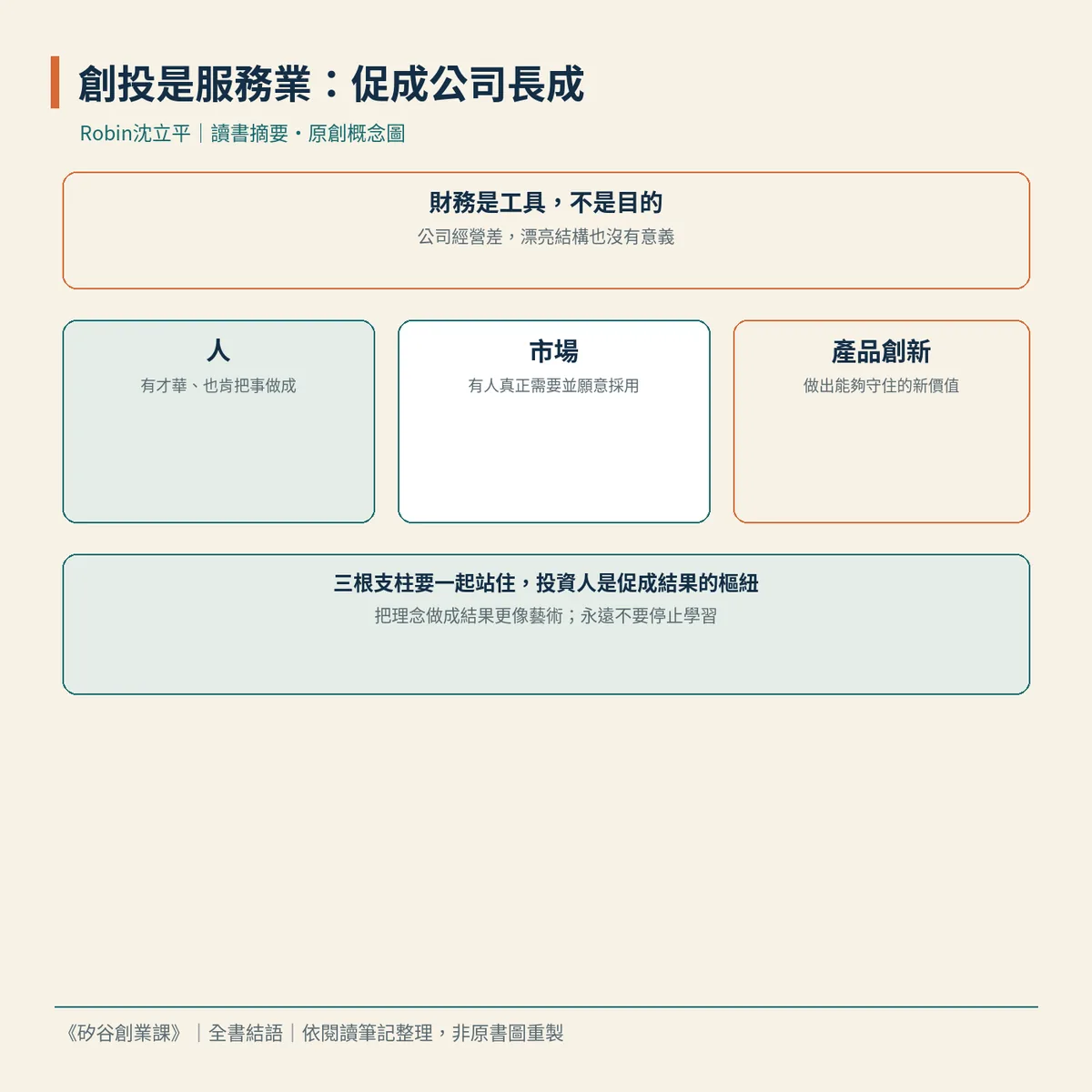
A Dozen Lessons for Entrepreneurs — Conclusion
In the book’s conclusion, Tren Griffin defines venture capital as a service business. It requires hard work, intelligence, good judgment, and some luck. The investors he respects enjoy spending time building real companies. Finance is a tool for making that happen, not an end in itself. If a company is poorly run, even the most elegant financial structure or largest ownership stake is meaningless.
The author uses a “three-legged stool” to describe the three pillars that generally need to hold together for a venture investment to become a successful company: people, market, and product innovation. Different investors emphasize different legs at different times, but the stool struggles to stand steadily without any one of them. The different emphases of the more than 30 investors discussed earlier show that these pillars can be approached from different directions, yet one can hardly replace the others entirely. Successful companies often need to get several things right at once and become capable of continuing to grow on their own. Talented, hardworking employees, user acceptance, partners, brand value, and capital reinforce one another. Under the right conditions, that reinforcement can produce nonlinear growth and make possible a few outcomes that are both large enough and genuinely distributable. The investor’s job is to serve as a hub that helps bring this about: directing judgment, resources, and time where they can actually make a difference, rather than simply cheering on the valuation from the sidelines.
He presents putting ideas into practice as more art than science. No checklist guaranteeing success can replace decisions under uncertainty and revisions based on new evidence. What you can do is keep improving their understanding of people, markets, and products, keep learning, and acknowledge luck’s role. The book’s closing line is: never stop learning. For readers of these investors’ conversations, this is not a sign-off. It is a way to bring all the preceding judgments into daily work. Every allocation of capital, every hire, and every product change can still be questioned more precisely.
The conclusion: as a service business, venture capital creates value by using judgment and time to help real companies grow. People, markets, and product innovation must stand together. Finance is only a tool. There is no ready-made formula for turning ideas into outcomes. Keep learning, and when luck arrives, give the parts already working a chance to grow in impact.
One deeper insight
I think the easiest thing to remember after reading the book is each investor’s signature move. Perhaps the more useful thing to take away is the three-legged stool: people, market, and product become unstable if any leg is missing, and financial sophistication cannot compensate for a poorly run company. If learning stops here, the preceding summaries become merely a collection of remembered lines.
Three suggestions
First, use one page to describe the company you are building or evaluating: what currently supports each pillar of people, market, and product innovation, which is weakest, and whether the financial structure advances these three things or merely dresses up the numbers.
Second, list where you, as a founder or investor, can genuinely commit time and judgment over the next month. If the list contains only meetings and valuation discussions, add a concrete task that directly helps the product, customers, or team.
Third, choose a judgment you think you have already settled. Write down what more you could learn and what new evidence you would use to revise it. Turn “never stop learning” into a hypothesis you will change next time, rather than a closing line.
#ADozenLessonsForEntrepreneurs #TrenGriffin #ReadingNotes
These are reading notes and reflections based on my personal understanding. I recommend reading them alongside the original book for the full context.
Comments
What do you think? Share your experience or questions.
Sign in to comment, reply or like. Sign in / Sign up
Loading comments…