Note 5 | Use Seed Capital to Buy Validation and Room to Maneuver, and Find Investors Who Can Actually Help
These are Robin Shen’s original reading notes and commentary, written in his own words after reading Tren Griffin’s A Dozen Lessons for Entrepreneurs. They are not the original book, excerpts from it, or an official publication. Methods and concepts from the book are attributed to Tren Griffin; other sources are identified where stated. For reference only; not investment advice.
English translation of Robin’s Chinese reading notes and commentary. Passages are paraphrased, not verified verbatim quotations from the original English edition.
A Dozen Lessons for Entrepreneurs — Chapter 5, “Steve Anderson: Baseline Ventures” (Part II, “The Venture Capitalists”)
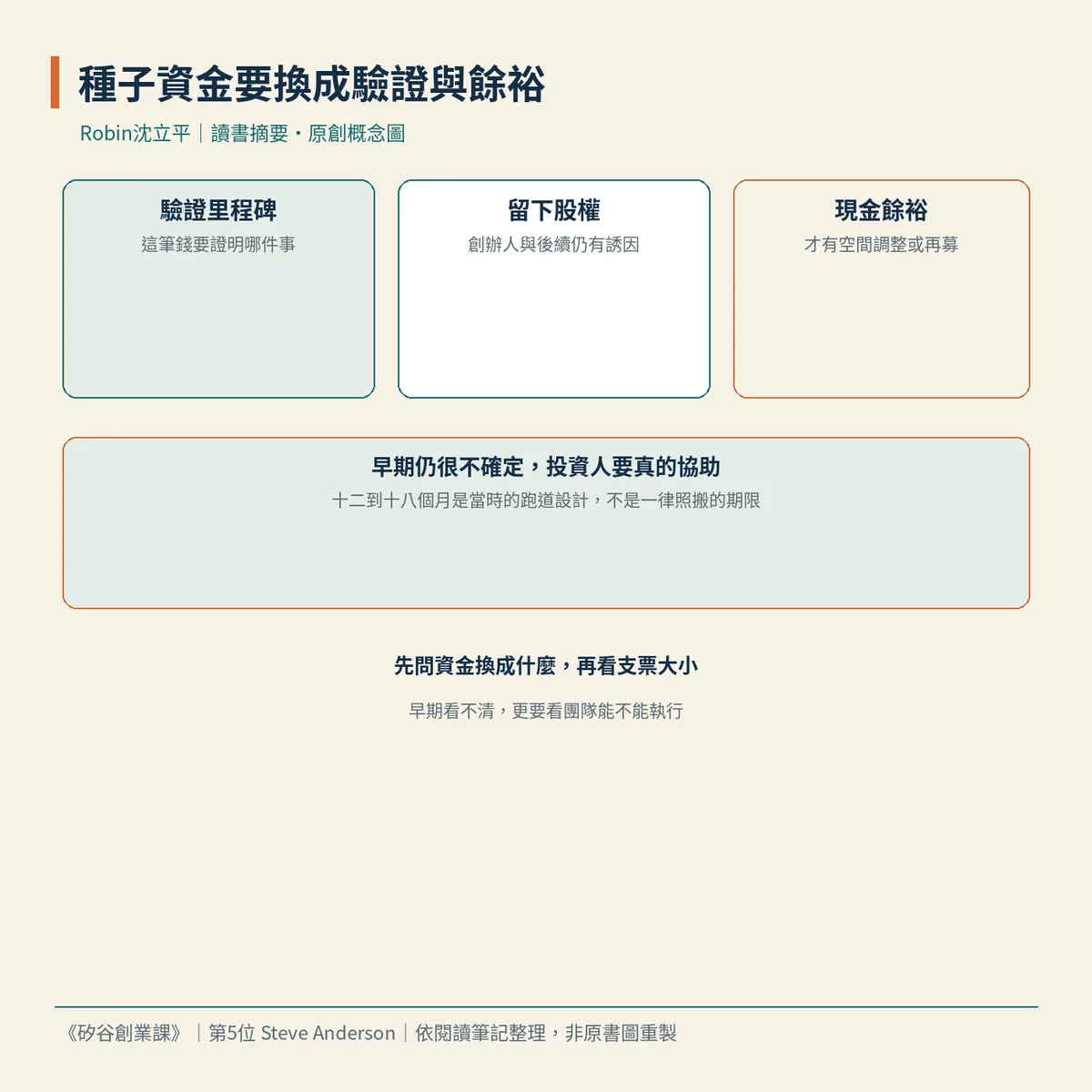
The book identifies Steve Anderson as the founder of Baseline Ventures, a fund focused on startup seed rounds and run by a single decision-maker. A seed round should mean more than “getting some money first.” Start by asking what the money needs to validate and how much equity and cash flexibility it will leave. When the product remains highly uncertain, you also need investors who can actually help, rather than simply hand the company capital.
Anderson points out that every traditional fundraising round sells a portion of the company’s equity. The author explains that investors have limited time to devote to companies and may therefore seek a larger stake. Founders need to consider dilution, control, and the help an investor can provide together. The author also uses examples of smaller checks spread across multiple seed companies to show that each investment need not be large. The author also cautions that too much cash can make early-stage companies inefficient. Preserving equity keeps incentives in place for founders, employees, and investors who join later.
The immediate purpose of this money is to buy enough time for validation. Anderson aims to provide roughly twelve to eighteen months of funding to keep the company alive and let it test its assumptions. The author adds that preserving a cash cushion gives founders more room to change direction or reconsider their goals. If they wait until cash is nearly exhausted to start raising the next round, they may not finish in time. This was his funding approach at the time, rather than a fixed timeline every company should copy. Many seed investments happen before product launch, or even at the concept stage. That means making judgments under high uncertainty, with an even greater emphasis on whether the team can execute. In later rounds, it is usually easier to see what you are investing in. Seed investing lacks that clarity and relies more on the team and experience.
Precisely because the early picture is unclear, investors’ work goes beyond providing money. Anderson spends time building relationships with entrepreneurs and meets more people through them. The author cautions that referrals can bring opportunities, but the company and market still need scrutiny. Connections cannot replace judgment. Incubators suit founders with limited networks who find it harder to establish relationships on their own. They can improve visibility, but not every company has to take this route. Anderson also says every investor misses some opportunities. The point is to learn from mistakes. Founders, too, should avoid treating a rejection as personal.
The conclusion: seed capital should first serve validation milestones while preserving equity and a cash cushion. Twelve to eighteen months is only one runway design used at the time. Plan around your own spending and the time needed for the next round. Early-stage uncertainty makes it even more important to choose investors who can actually help the company, rather than judging only by check size.
One deeper insight
I think people discussing seed rounds often first ask how much they can raise. They less often ask what the money must prove or whether another choice will remain possible before it runs out. A more useful starting point is to write down what you must understand by the end of this period and, if it remains unclear, how much financial flexibility you need left.
Three suggestions
First, list the milestones your current seed capital needs to validate, roughly how long that will take, and how much cash must remain before and after validation. Do not copy someone else’s number of months. Calculate the timeline from your spending and the preparation time the next round may require.
Second, separately write down “How much equity will this round sell?” and “What incentives remain for founders, employees, and future investors?” If you see only the immediate amount raised and cannot see who else will need incentives later, complete that calculation before deciding whether to accept the investment.
Third, when choosing seed investors, list the specific things they can help with beyond providing money, such as hiring, assessing customers, or reviewing milestones together. If you cannot name those things, ask other founders what the investor actually did during the uncertain early stages.
#ADozenLessonsForEntrepreneurs #SteveAnderson #SeedInvesting #ReadingNotes
These are reading notes and reflections based on my personal understanding. I recommend reading them alongside the original book for the full context.
Comments
What do you think? Share your experience or questions.
Sign in to comment, reply or like. Sign in / Sign up
Loading comments…