Note 6 | Breakthroughs Are Hard to Predict and Winners Will Be Missed: Rely on a Portfolio, Long-Term Capital, and Practical Support
These are Robin Shen’s original reading notes and commentary, written in his own words after reading Tren Griffin’s A Dozen Lessons for Entrepreneurs. They are not the original book, excerpts from it, or an official publication. Methods and concepts from the book are attributed to Tren Griffin; other sources are identified where stated. For reference only; not investment advice.
English translation of Robin’s Chinese reading notes and commentary. Passages are paraphrased, not verified verbatim quotations from the original English edition.
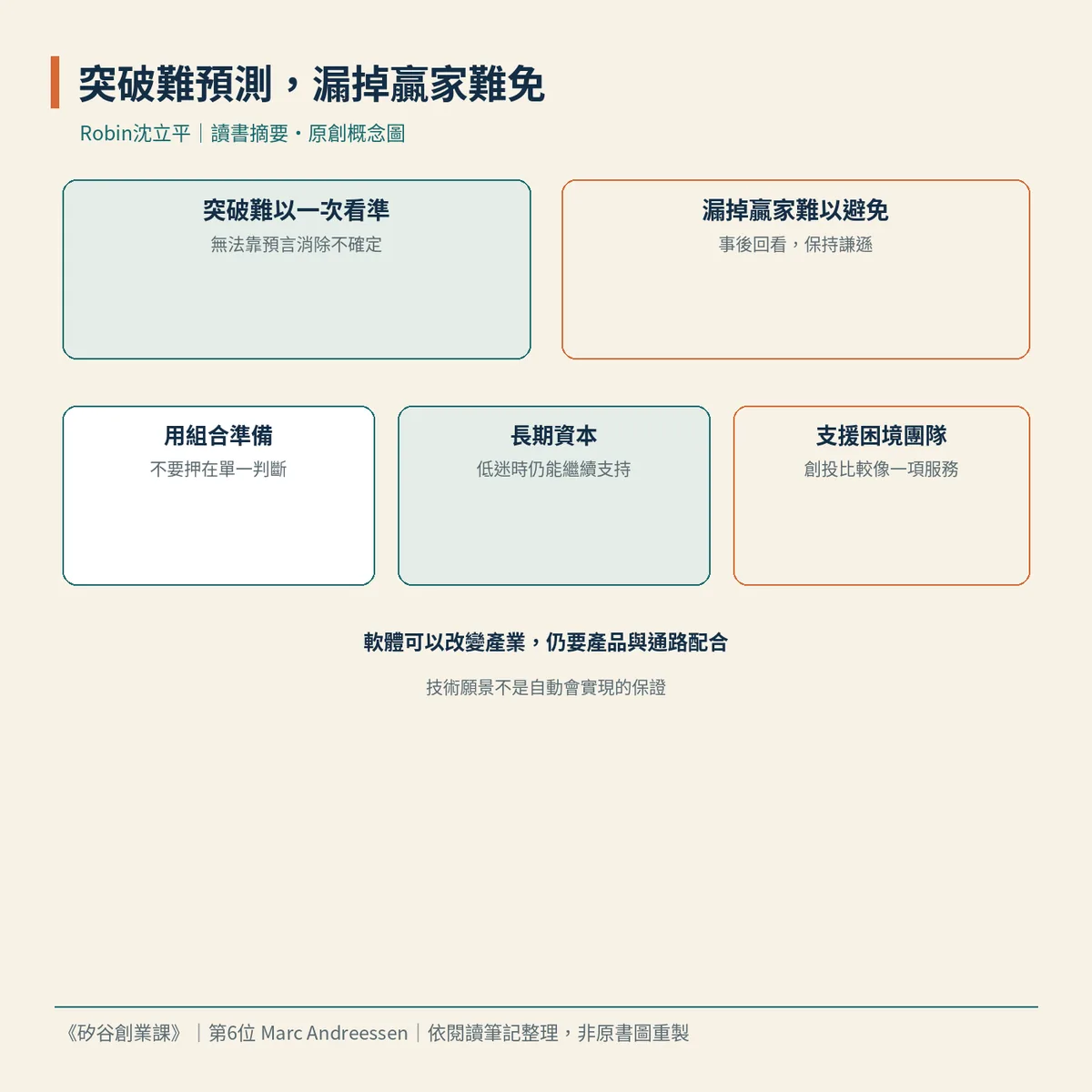
A Dozen Lessons for Entrepreneurs — Chapter 6, “Marc Andreessen: Andreessen Horowitz” (Part II, “The Venture Capitalists”)
The book introduces Marc Andreessen as an entrepreneur, investor, and engineer who developed the Mosaic browser with friends, founded Netscape and Loudcloud, and founded Andreessen Horowitz (a16z). He starts with an uncomfortable fact: genuine breakthroughs are hard to identify in advance, and missing eventual winners is difficult to avoid entirely. What you can more realistically do is handle that uncertainty through a portfolio, long-term capital, and real support when teams struggle, rather than claim to predict the future.
Andreessen believes it is hard to recognize a major idea on the first pass; in practice, it often cannot be predicted. The author relays Howard Marks’s caution: the future is difficult to predict accurately, but you can still prepare. Rather than bet on one prediction, keep some opportunities in the portfolio that are currently undervalued and could produce large returns if they work. Disagreeing with the crowd does not automatically make you right. Either success or failure is possible. The duration of capital also affects judgment. Venture capital is typically locked up for longer, which the author connects to a startup investment cycle of roughly ten years. Keeping capital available puts you in a better position to continue backing companies that deserve support during a downturn, rather than being forced to cut short an assessment still in progress because the capital has already left.
Another thing that is almost impossible to eliminate is missing companies that later do very well. Andreessen says one thing venture investors share is missing most technology companies that eventually succeed. Even experienced investors miss these opportunities. The point is to stay humble and review decisions afterward, rather than believe a process can guarantee you will never miss another winner. The author also writes that a company that looks successful from the outside may feel close to failure internally. Departures, competitive attacks, and outside criticism often arrive together. That is why investors spend much of their time on struggling portfolio companies. Companies doing well do not necessarily need as much intervention; struggling teams have a greater need for help finding talent, thinking through distribution, and solving immediate problems. Here, venture capital is more like a service than simply sitting back and selecting investments.
“Software is eating the world” summarizes the possibility that software will transform many industries. The author then cautions that products and technology matter, but cannot replace distribution and the ability to get something into users’ hands. Software creates opportunities to remake more industries, but whether a vision holds still depends on whether the product has real value and how people discover and use it. Treating a technological direction as a guarantee is the same kind of misjudgment as believing you can spot a breakthrough correctly on the first try.
The conclusion: because breakthroughs are hard to predict and missed winners are hard to avoid, investors should prepare through a portfolio, use longer-term capital to weather cycles, and provide practical help when companies struggle. Software can reshape industries, but product and distribution still have to work together. Humility is more than a posture: it means recognizing the limits of judgment and adjusting resources as new evidence appears. Support for struggling companies must be concrete, but it is not an unlimited commitment.
One deeper insight
I think that when discussing broad trends, the easiest mistake is to turn “the technology we believe in” into a statement of what is about to happen. More useful questions are: If this judgment takes longer to prove out, can our portfolio and capital sustain us through the interval? If one company struggles first, what can we actually help it do?
Three suggestions
First, review several directions you are currently pursuing. Separately write down “Why do we think this may be undervalued?” and “If we are wrong, what else in the portfolio can absorb this miss?” If you cannot answer the latter, do not commit all your resources to the same prediction.
Second, if you manage or use longer-term capital, write down the minimum time it must remain available to support your assessment and several things you intend to keep doing if the market deteriorates. Avoid imposing the pace of short-term capital movements on companies still validating their businesses.
Third, choose the task that currently needs the most help. Specify the talent, distribution channel, or immediate problem you can help with. Intervene less where operations appear to be going well, and save time for where things are truly stuck.
#ADozenLessonsForEntrepreneurs #MarcAndreessen #ReadingNotes
These are reading notes and reflections based on my personal understanding. I recommend reading them alongside the original book for the full context.
Comments
What do you think? Share your experience or questions.
Sign in to comment, reply or like. Sign in / Sign up
Loading comments…