Note 7 | Unlock Industry Information, Start Manually, Then Grow Demand on Both Sides Together
These are Robin Shen’s original reading notes and commentary, written in his own words after reading Tren Griffin’s A Dozen Lessons for Entrepreneurs. They are not the original book, excerpts from it, or an official publication. Methods and concepts from the book are attributed to Tren Griffin; other sources are identified where stated. For reference only; not investment advice.
English translation of Robin’s Chinese reading notes and commentary. Passages are paraphrased, not verified verbatim quotations from the original English edition.
A Dozen Lessons for Entrepreneurs — Chapter 7, “Rich Barton: Expedia, Glassdoor, Zillow” (Part II, “The Venture Capitalists”)
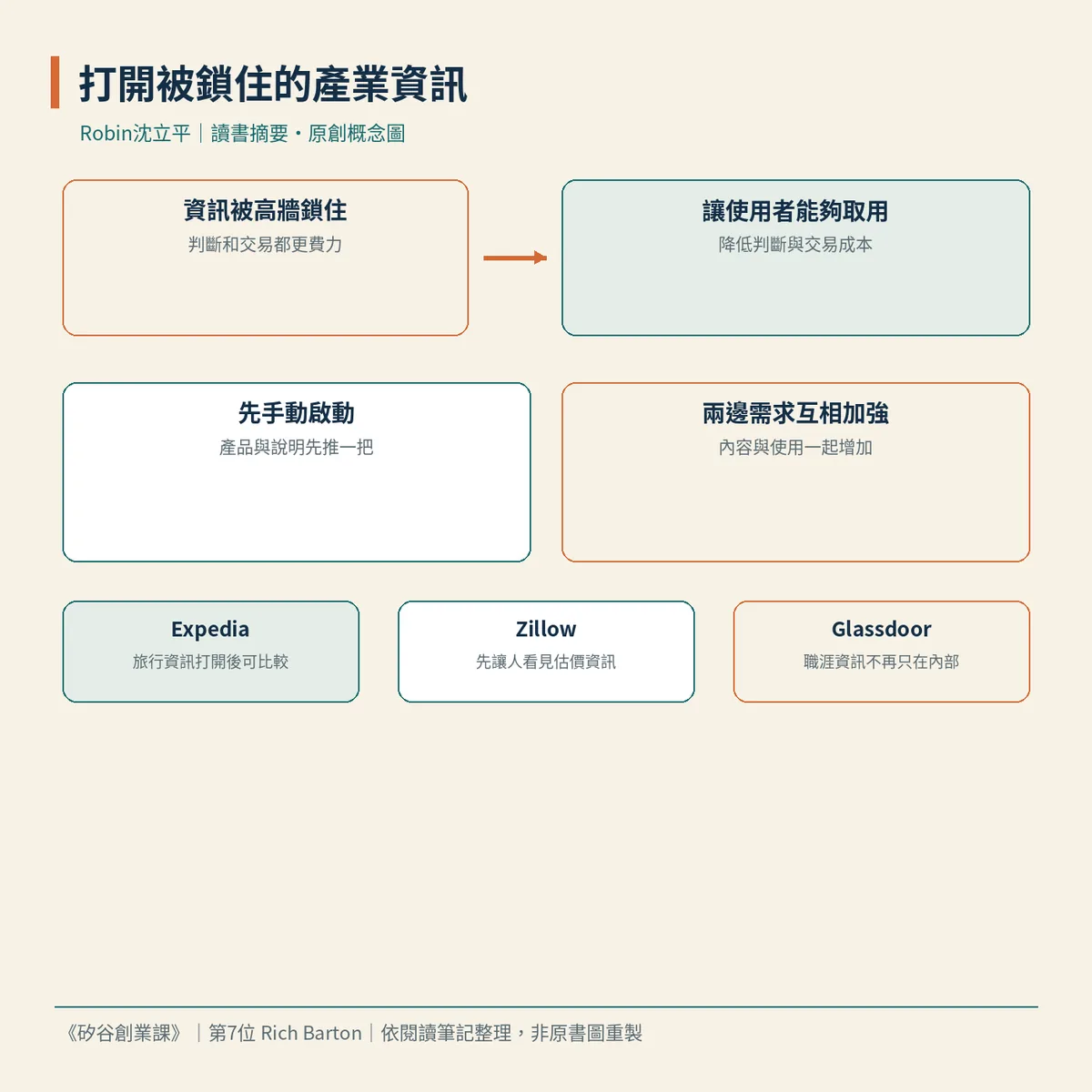
The book describes Rich Barton as an entrepreneur and investor who founded Expedia while working at Microsoft and later cofounded Zillow and Glassdoor. These companies share an approach: unlock information within vertical industries so users can make judgments and complete transactions more easily. Getting the market moving often requires manual work at first. Only later can content and both sides of supply and demand create a self-reinforcing process.
Barton recalls initially focusing on large vertical industries whose databases were behind high walls. He wanted users to have access to this information. Once real people, decisions, and transactions entered the picture, the industry also became easier to understand. The author uses accessible information such as reviews and property estimates to explain how the barriers to judgments that once took considerable effort can fall. When information is locked away and users incur high costs to make judgments and transact, a service becomes more useful by giving them access to information that is appropriate to make public and helpful for decisions. Charge where charging works, and provide information free where that works. The point is for users ultimately to know what they need to know to make a decision.
Such markets often start with too little on both sides. Without enough content, attracting people is difficult; without enough people, content does not grow. Barton uses takeoff as a metaphor: until the market can sustain itself, it is worth getting it moving through less economical, more manual methods. The author explains that when a team has limited capital and cannot buy advertising at scale, it must rely even more on the product itself and public explanations. Get one side interested before the other leaves, and bring both sides to a basic scale. The Zillow-related valuation product mentioned in the book is an example of first making information visible to attract attention. More content attracts more people who come later; more people bring more content. That feedback must rest on genuinely useful information.
Ideas are relatively easy; actually building the market remains difficult. The author explains that you still need to assemble a team, build the product, establish that a sufficiently large and serviceable market exists, and keep executing. If you choose the wrong market, even a strong team will struggle to get results. Investors who can provide money but cannot help with the business also offer limited value. Each of these conditions needs validation. You cannot replace that work with “the information will surely spread on its own.”
The conclusion: unlocking industry information is about reducing users’ costs of making judgments and transacting. A cold start often needs a push through manual work, the product, and explanations. Only when demand and content on both sides begin reinforcing each other does the market become more sustainable. A new service will not spread by itself; its mechanism needs to stand up to scrutiny.
One deeper insight
I think people discussing platforms often jump straight to “build it and users will come.” It is more useful to write down which information is currently locked away and makes decisions difficult, who will initiate the first content or transactions and by what specific means, and when you can reduce manual work and start examining whether the two sides are actually generating demand for each other.
Three suggestions
First, choose a market you are working in or considering. Write down which type of information users struggle most to obtain when making judgments or completing transactions, and where their costs would fall if it became accessible. If you cannot specify what would decrease, it is too early to discuss scaling.
Second, design a manual checklist for the cold start: whom to approach for the first content or demand on one side, how the product or public explanations will persuade them to participate, and what would count as basic scale on both sides. Do not put the entire budget into advertising at scale from the outset.
Third, write down why additional content will attract more users and how those users will bring new content or transactions. If this feedback rests only on hope, with no observable steps, return to whether the product actually helps people make better judgments.
#ADozenLessonsForEntrepreneurs #RichBarton #ReadingNotes
These are reading notes and reflections based on my personal understanding. I recommend reading them alongside the original book for the full context.
Comments
What do you think? Share your experience or questions.
Sign in to comment, reply or like. Sign in / Sign up
Loading comments…