Note 8 | Entrepreneurship Does Not Automatically Fit Venture Capital: Check Customer Value, the Market, and the Funding Model First
These are Robin Shen’s original reading notes and commentary, written in his own words after reading Tren Griffin’s A Dozen Lessons for Entrepreneurs. They are not the original book, excerpts from it, or an official publication. Methods and concepts from the book are attributed to Tren Griffin; other sources are identified where stated. For reference only; not investment advice.
English translation of Robin’s Chinese reading notes and commentary. Passages are paraphrased, not verified verbatim quotations from the original English edition.
A Dozen Lessons for Entrepreneurs — Chapter 8, “Roelof Botha: Sequoia Capital” (Part II, “The Venture Capitalists”)
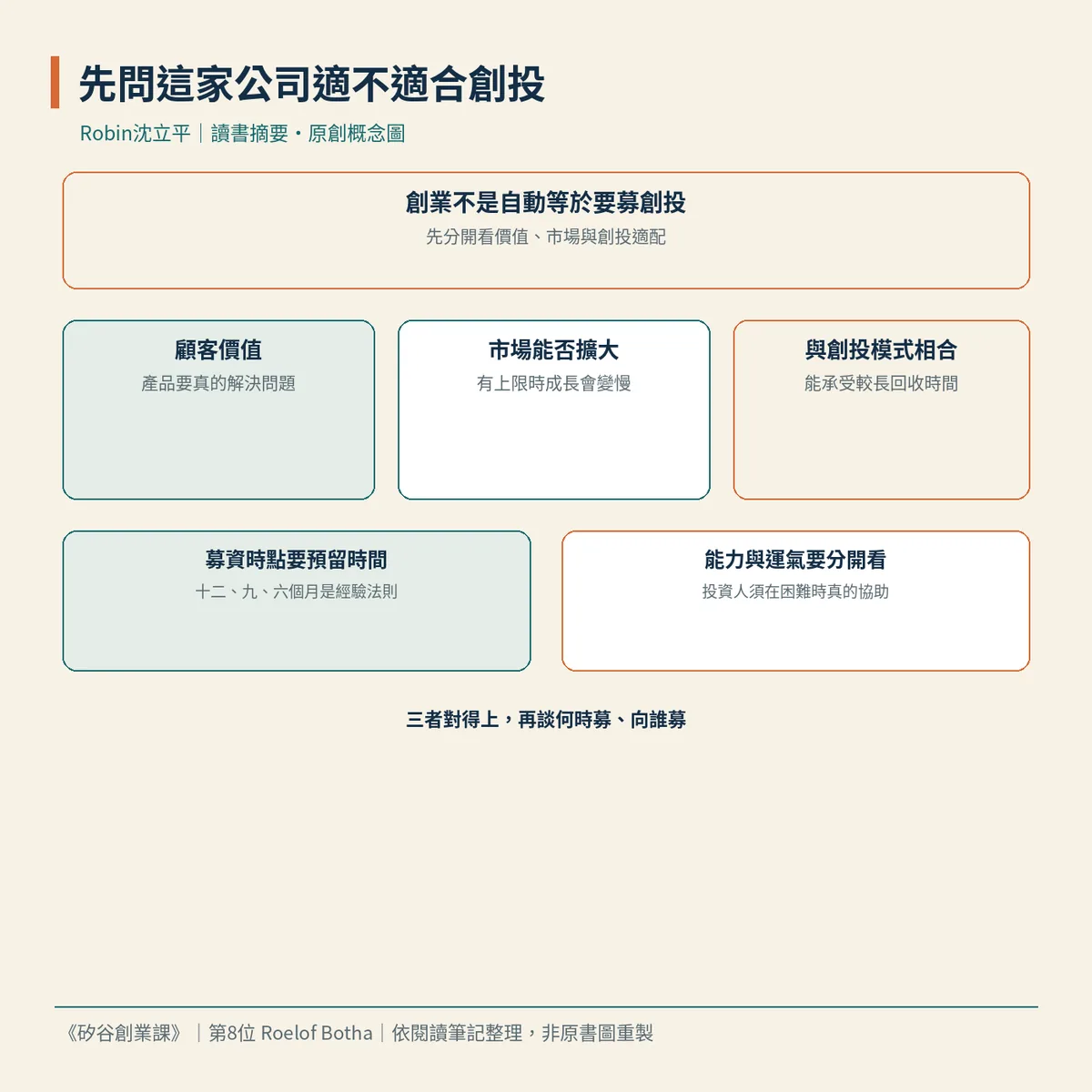
The book identifies Roelof Botha as a partner at Sequoia Capital. Distinguish two questions first: Is the business solving a real problem for customers, and is the company suited to venture capital? They are different questions. Examine customer value, the market’s potential to expand, and whether the company can accommodate venture capital’s longer, more uncertain timeline for realizing returns. Then consider fundraising timing, the support investors can provide, and the distinction between skill and luck.
Botha believes a desire to solve users’ problems is an important entrepreneurial quality. Wanting only to build a very large company, or joining because there is money to be made, is a different starting point. The author goes on to explain that if a company cannot offer a product with real value, neither a growth model nor fundraising terms can fix that. Entrepreneurship means far more than securing venture capital. Many startups do not suit the venture capital model. Venture funding is one possible path to growth, rather than a path every company should take. Even if expansion is the goal, first ask whether the market is large enough and how much room for growth remains. Growth will eventually slow when a market has a ceiling. This is not an invitation to describe the market as large as possible. It is a reminder that companies suited to venture capital generally need the opportunity to scale something valuable. They must also fit a model that requires long-term patience and may take many years to show results.
If you choose this route, the funding cadence becomes very practical. Botha cautions that some companies become complacent after raising too much money, lose criticism and scrutiny, and quickly fall into crisis when setbacks arrive. The author lists rules of thumb: start considering fundraising when about twelve months of cash remain, begin the process with about nine months left, and be alert when only about six months remain. Later rounds are often harder than seed rounds. These timelines are rules of thumb in the book, rather than uniform requirements for every company. You can also work backward from your own situation. Leave enough time in advance for the preparation the next round itself requires, plus enough cash for daily spending. Botha advocates choosing investors who are not rushing to exit, can work with you over the long term, and genuinely devote time when the company faces problems. The author explains that investors should provide concrete help with whether the product works, hiring, finance, and operations. Providing only money without participation has limited value. When time is limited, pay more attention to the companies most in need of help, rather than spending time only with those already doing well.
Major success is often shaped by both skill and luck. A company may be close to failure even when things look smooth from the outside, and small changes can lead to different outcomes. The author’s conclusion is that entrepreneurship requires skill, luck, and timing. You cannot infer someone’s ability solely from the outcome. Venture capital results may take three, five, or ten years to become clear, making capital that is not seeking a quick entry and exit all the more necessary.
The conclusion: first ask whether the product genuinely delivers value to customers, whether the market has room to expand, and whether the company fits venture capital’s long-term patience. If all three align, plan timing around your spending and the time fundraising requires, and choose investors who can support you through difficulty. Acknowledge both skill and luck. A single outcome cannot explain everything.
One deeper insight
I think teams sometimes begin growth discussions by assuming “of course we need to raise venture capital.” It is more useful to first write down whether, without that money, the business could survive by delivering genuine customer value. If the answer is yes, venture capital is an option, rather than a required route.
Three suggestions
First, write down three questions on one page: Who gets value, and why? Does this market have a meaningful opportunity to expand? Can the company’s growth pace accommodate venture capital’s longer timeline for realizing returns? If the three do not align, do not make “go raise money” the default next step.
Second, work backward from current monthly spending and the likely preparation time for the next round to determine when to begin approaching investors. Use the book’s approximate twelve-, nine-, and six-month guidelines as a comparison, rather than adopting them directly as company rules. Also write down how you would maintain scrutiny if you raised substantially more than current validation requires.
Third, if you are already considering investors, list what they can specifically help with during difficult stages and whether they are in a hurry to exit. Check those claims with other founders. When reviewing results, separately identify what appears to come from skill and what was clearly influenced by timing or luck.
#ADozenLessonsForEntrepreneurs #RoelofBotha #ReadingNotes
These are reading notes and reflections based on my personal understanding. I recommend reading them alongside the original book for the full context.
Comments
What do you think? Share your experience or questions.
Sign in to comment, reply or like. Sign in / Sign up
Loading comments…